The Cybertruck reached Weston driveways before its care manual did. Bare stainless steel behaves nothing like paint: it magnetizes fingerprints, spots dramatically under hard irrigation water, and punishes any product formulated for clear coat. What follows is how one owner learned that the hard way — and the exact protocol we now use on every stainless panel we touch.
Stainless Steel Cleaner — Unidirectional Motion
For the marks Andrés had created with his circular microfiber cleaning, we used a dedicated stainless steel cleaner applied with a microfiber pad in strictly unidirectional strokes — always following the direction of each panel's brush finish. Minimum pressure, long deliberate passes. This process takes twice as long as on conventional paint because any error is immediately visible.
Diluted Oxalic Acid — For Surface Oxidation
The brown tea staining marks that had appeared on the Cybertruck's lower panels required highly diluted oxalic acid applied with precision. Oxalic acid dissolves oxidized iron deposits without attacking the base steel. Applied with an applicator pad, 3-minute dwell time, then neutralized with deionized water. This is the only safe treatment for Cybertruck tea staining.
Coating Formulated for Bare Metal
Conventional ceramic coatings are formulated to bond with automotive clear coat. On bare stainless steel, you need a coating specifically designed for uncoated metal surfaces — we use 22PLE VM1 Elite, a coating engineered for paintless metallic finishes. Application follows the brush finish direction, with a longer flash time than on paint. The result: a hydrophobic surface that repels water, salt, and fingerprints for 2–3 years.
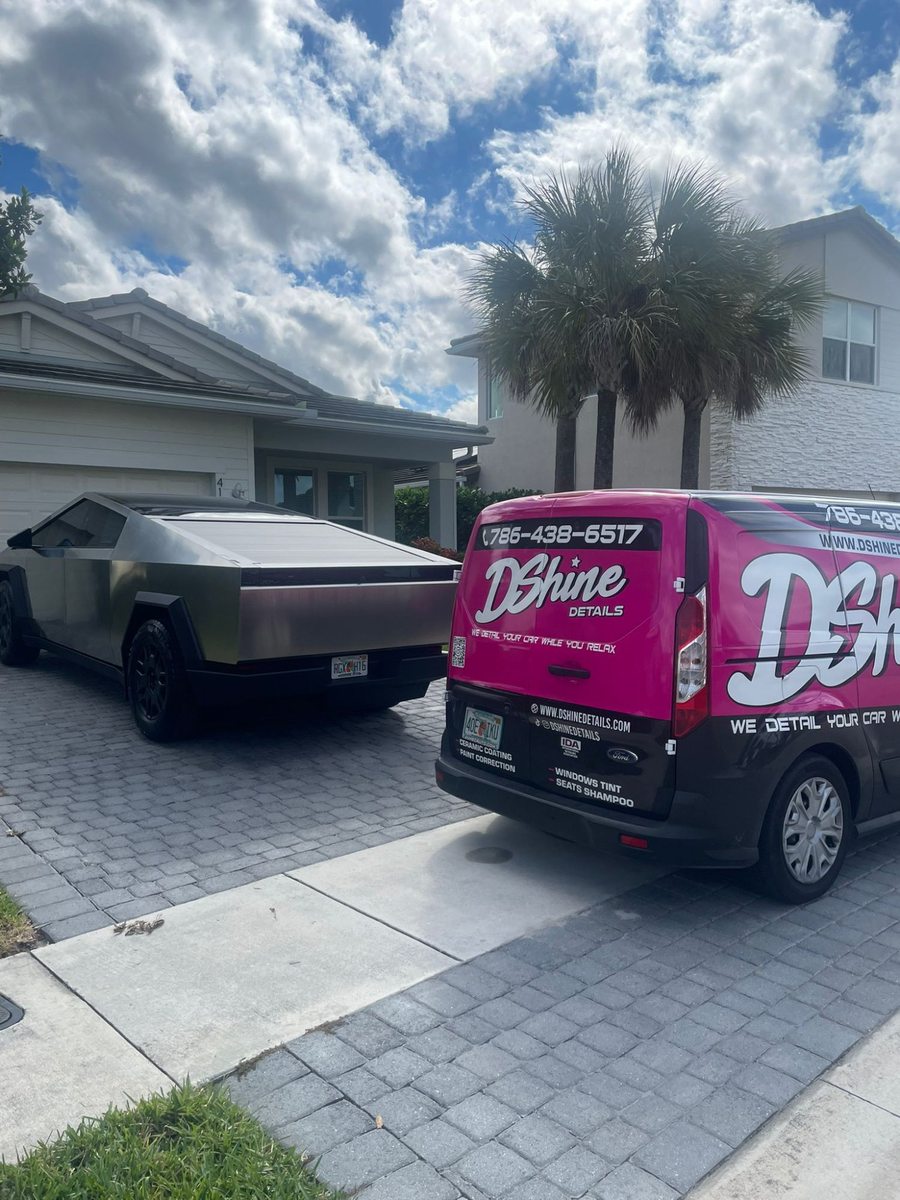
Cybertruck Foundation Series — Weston FL. Stainless steel treated and protected with bare metal ceramic coating
What Andrés Learned — and You Should Too
At the end of the process, Andrés asked us a question that summarizes everything: "Why doesn't Tesla explain any of this in the manual?"
The honest answer: because proper Cybertruck maintenance requires specific knowledge of metal treatment that goes beyond conventional detailing. Tesla assumes owners will bring the vehicle to professionals with that expertise. DShine offers specialized mobile detailing in Weston with stainless steel protocols. Most owners discover this after creating marks while trying to care for it themselves.
What Andrés does now: ceramic coating maintenance every 14 months, full detailing every 4 months, and between services, hand washing with the products and technique we taught him. The Cybertruck in South Florida can be kept immaculate — it just requires the right protocol.