What a Margate Mold Job Includes
This is not a car wash. Car Mold Removal uses Concrobium Mold Control treatment, pH-balanced products, and machine assistance, the same process used in pre-sale preparations for luxury dealerships.
Why it matters for your health: Mold in a vehicle is a different exposure than mold on a wall at home. With the AC recirculating, everyone inside is breathing concentrated spores for the length of the drive. The EPA and CDC both link mold exposure to respiratory irritation, allergic reactions, headaches, and worsened asthma symptoms. Children, older passengers, and anyone with a compromised immune system typically react faster and more severely than a healthy adult would. By the time the smell is noticeable, spores have usually already spread through the HVAC system into every vent in the cabin.
Curious what actually happens during the visit? Tap through our real 11-step process below to see what we do at each stage and why it matters.
What every Margate mold job gets you
Most detailers in Margate charge less. Here’s exactly what you gain — and what you risk — with each choice.
| DShine DetailsFrom $549 · travel included | Avg Margate Detailer$149 – $199 | |
|---|---|---|
| Industry certificationsIDA, Koch Chemie, Meguiar’s, 3M, Symplex, XPEL | ✓6 verified | —0 credentials |
| $2M liability insuranceWe cover any damage — in writing | ✓ | —Often uninsured |
| Deionized water systemZero mineral residue, no water spots | ✓ | —Tap water, water spots |
| Fresh microfibers per vehicleNo cross-contamination between jobs | ✓ | —Shared towels, swirl risk |
| Mold-specific chemistry onlyConcrobium, Benefect & Meguiar’s, no harsh acids | ✓ | —Industrial degreasers |
| Before & after photosSent via WhatsApp on completion | ✓ | —No documentation |
| 100% written satisfaction guaranteeReturn & redo at no cost if unsatisfied | ✓ | —No written guarantee |
| Travel to your address — $0Home, office, condo — no drop-off | ✓ | Sometimes adds fee |
DShine vs. any other detailer
in Margate, Broward County
Three things most detailers won't tell you. We put them in writing.
 Since 2018
With more than 20 years of hands-on experience in the automotive care industry, Evelio launched DShine Details in August 2018 with one van and zero shortcuts. For the first six months he slept in the van to keep costs down and standards up. Today DShine runs 7 certified vans across Miami-Dade, Broward, and Palm Beach, and the commitment hasn't changed. Every vehicle is treated as if it were his own.
What clients say
in their own words.
Before & After: Mold Removal We've Actually Done
No stock photos. These are real DShine mold removal jobs across South Florida, the same 11-step process and chemistry used on every Margate appointment.
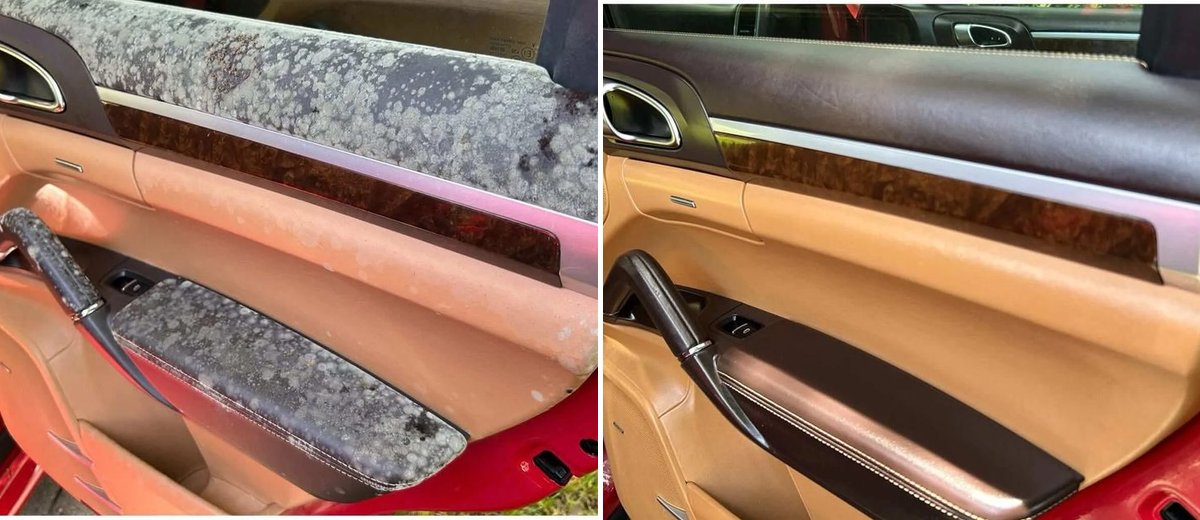
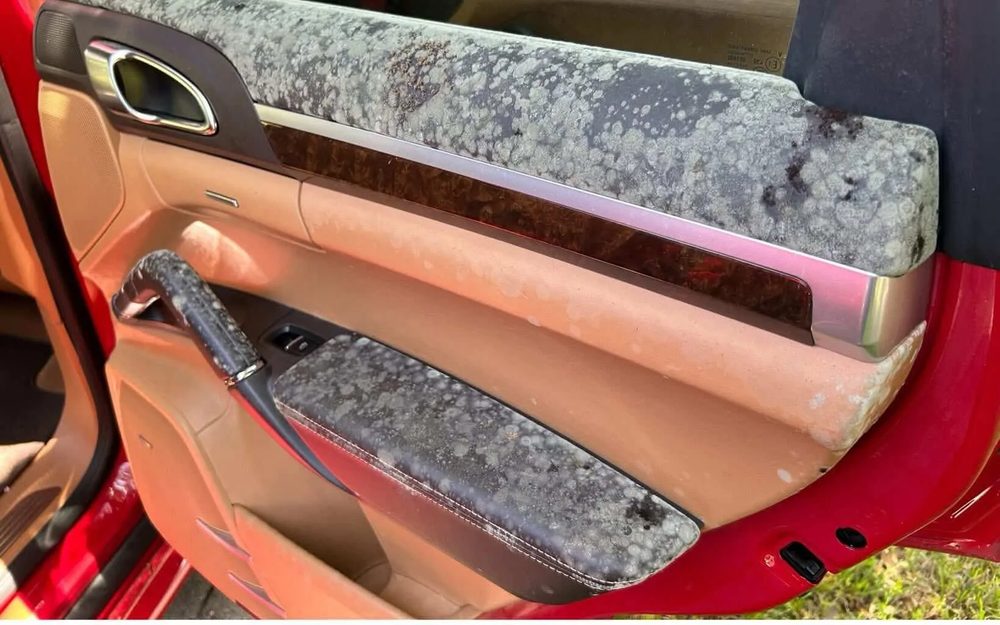 Before
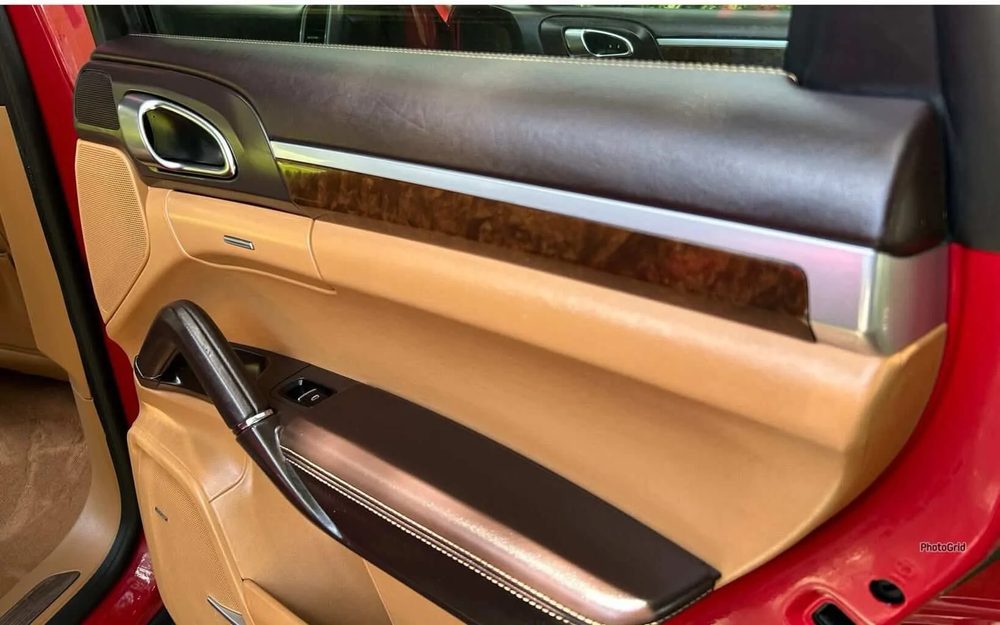 After
Porsche Cayenne — Door Panel & Armrest
Mold across the tan leather door panel and armrest of a red Porsche Cayenne, running up to the wood trim. Leather like this gets the leather-safe protocol: controlled steam and extraction, Concrobium on the surface, then ozone for the cabin air, so the finish is not stripped. This pattern is common where a car sits under an open carport and the door panel on the exposed side picks up blown rain.
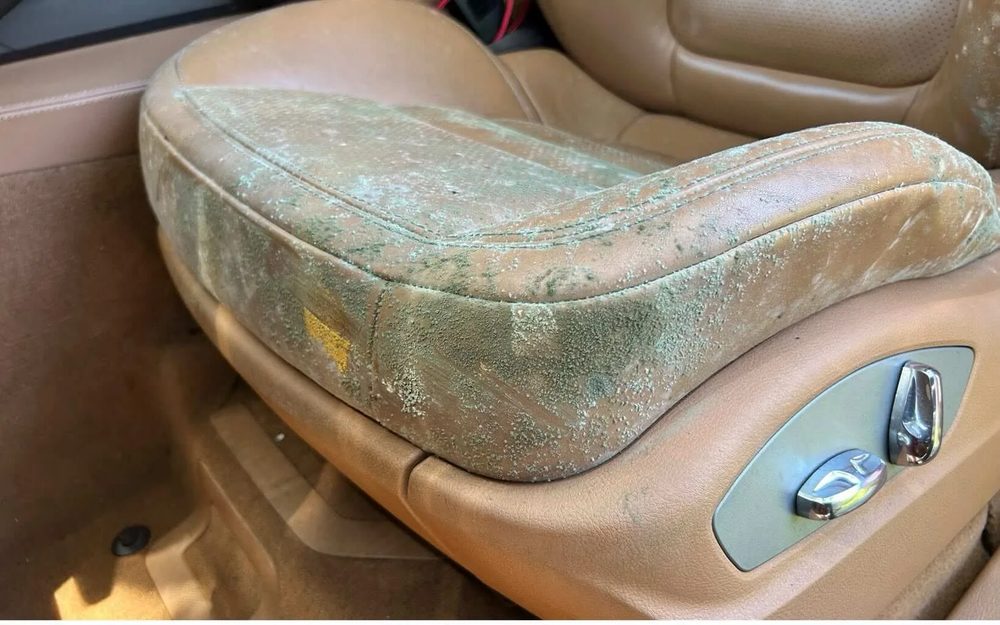 Before
 After
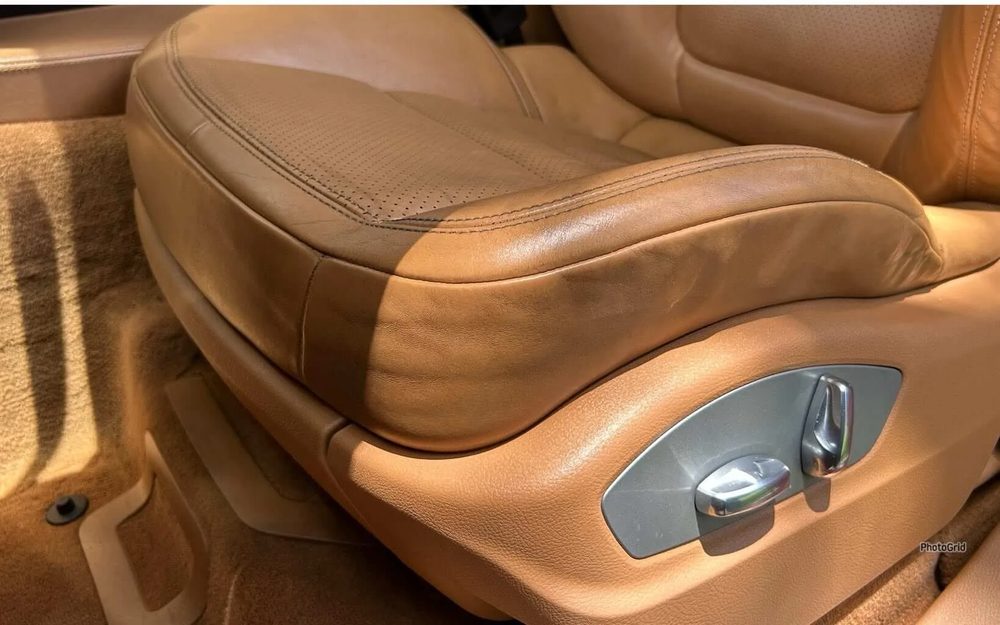
Leather Seat — Green-Blue Mold
A tan leather front seat bolster covered in green-blue mold. Leather is porous, so it needs a gentler method than cloth: steam, extraction, a Concrobium application and the ozone step, with the leather-safe protocol throughout. In Margate's wet season this shows up when a cabin stays shaded and damp, such as a car parked under a carport with the A/C off for days.
 Before
 After
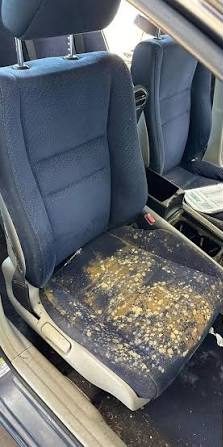
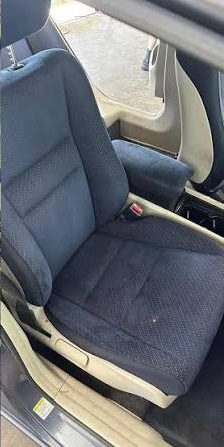
Cloth Bench Seat — Mold Staining Underneath
A dark blue cloth sedan bench seat with the cushion lifted, showing tan and yellow mold-stain residue on the underside of the seat bottom. Stains like this mean moisture reached the foam, so we steam and extract the fabric and treat the foam with Concrobium before drying and ozone. Pooled rain or a wet mat is a typical way water gets under the cushion in a humid climate.
 Before
 After
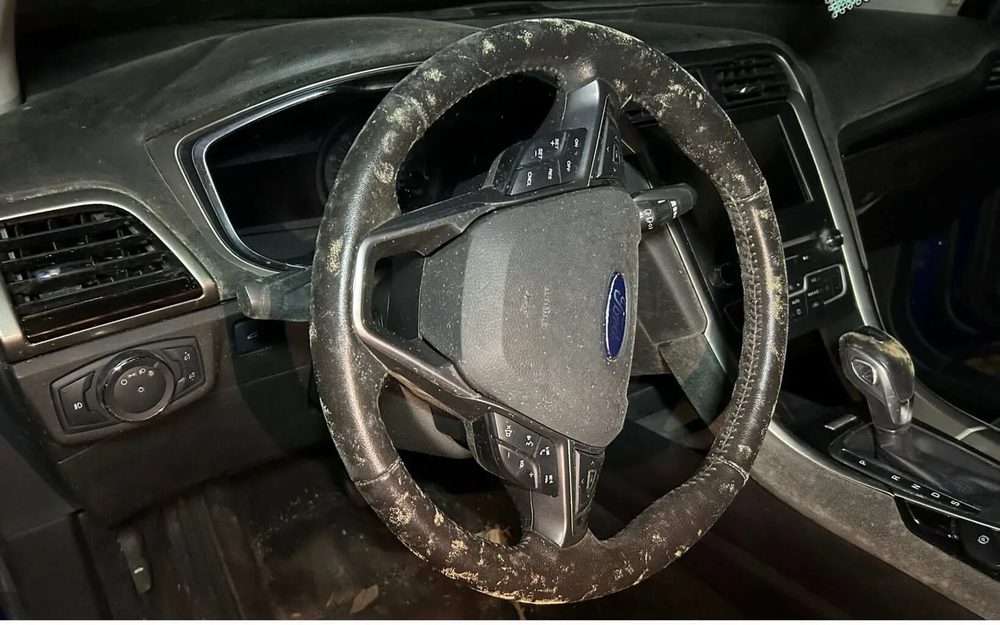
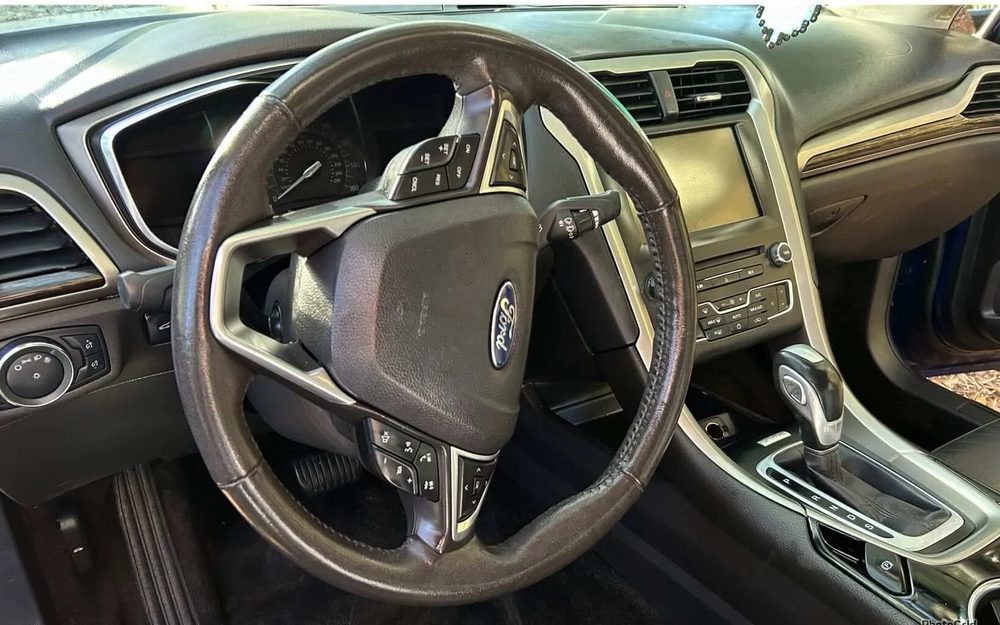
Steering Wheel & Dash — Gray-White Bloom
A Ford sedan interior with a gray-white mold bloom on the steering wheel, dashboard and vents. Hard surfaces and vents get steam, a Concrobium application and the ozone cycle, which reaches inside the vents where a wipe cannot. Growth on the wheel and dash often follows a cabin closed up with high humidity and little use, a common pattern for a car that moves once or twice a week.
 Before
 After
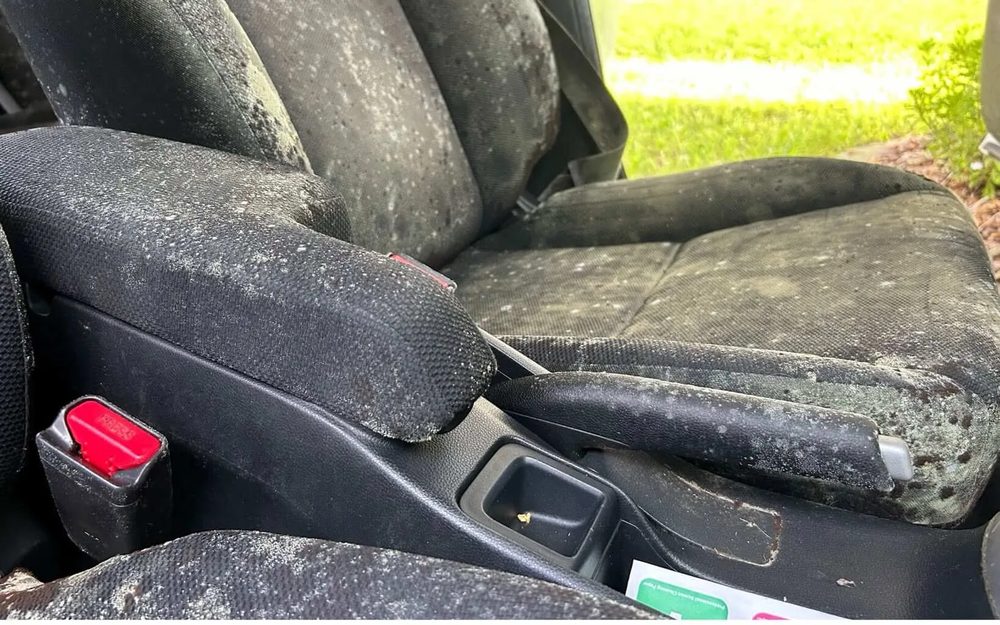
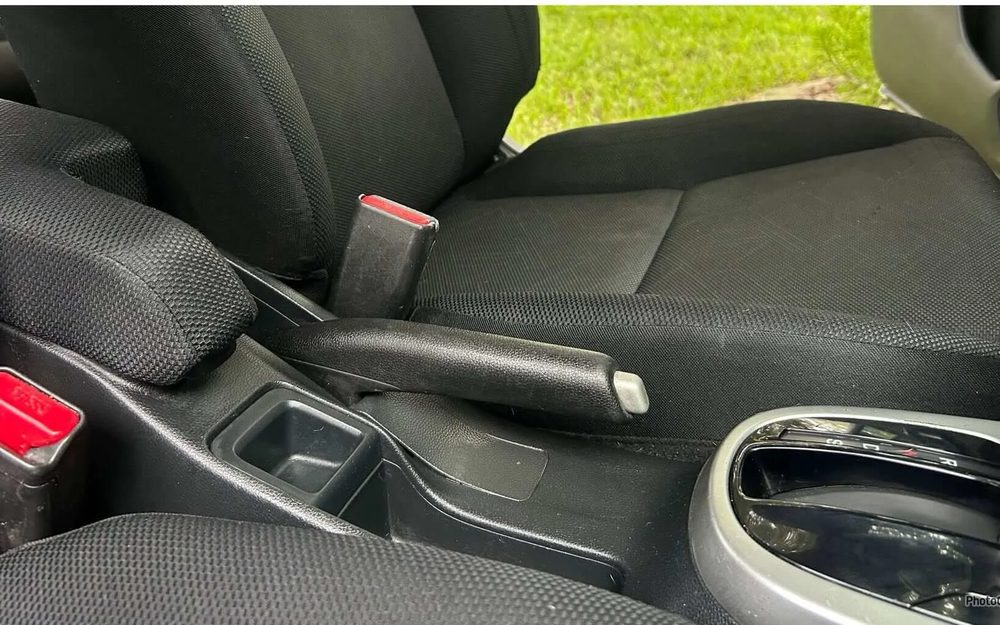
Black Cloth Seat & Console — Mold Bloom
A black cloth driver seat, armrest and console covered with a gray-white mold bloom, with green lawn visible outside the window. Dark cloth hides early growth until the surface goes powdery, so we vacuum with HEPA first, then steam and extract before Concrobium and ozone. Humid air plus a few days of A/C off is enough for this to start in a cabin that looks clean.
 Before
 After
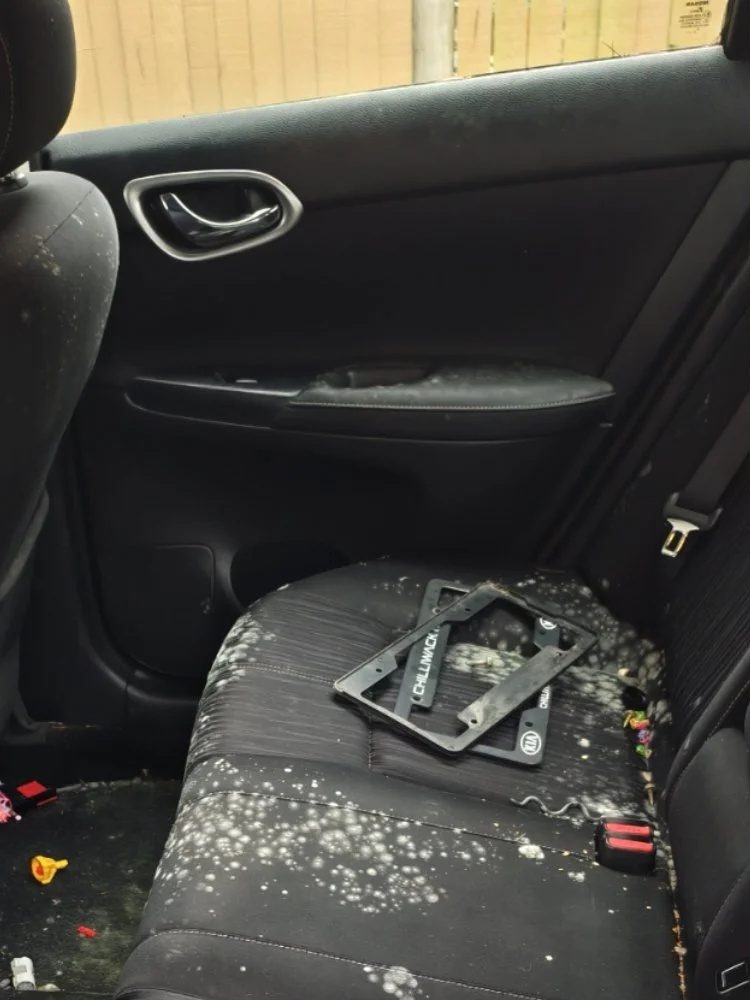
Rear Seat & Door Panel — White Spots
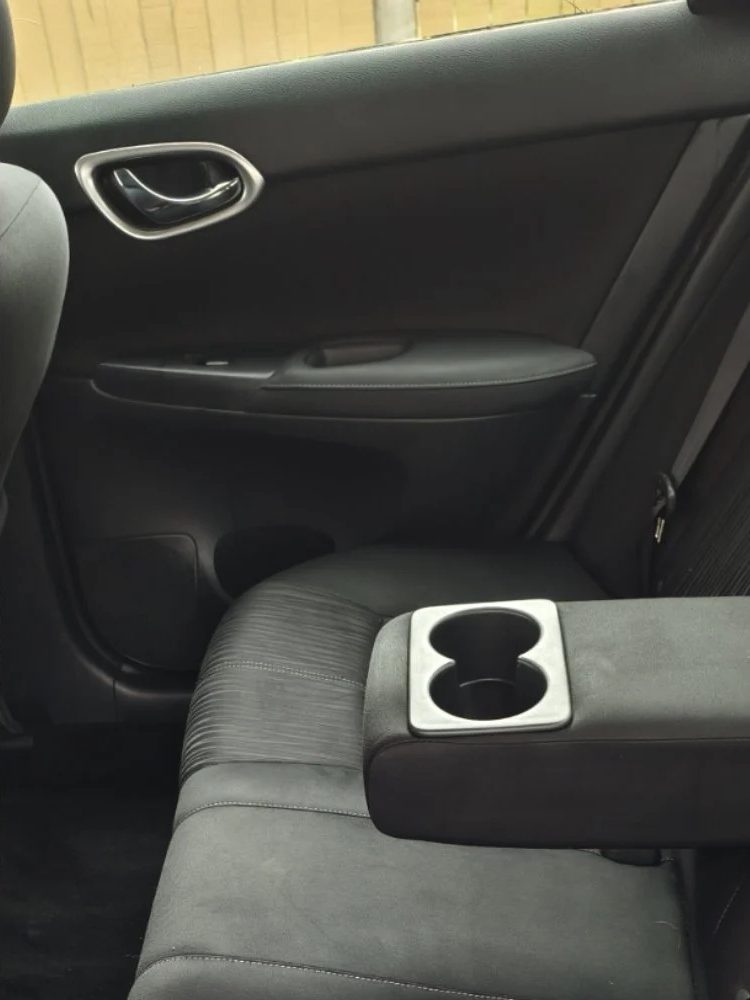
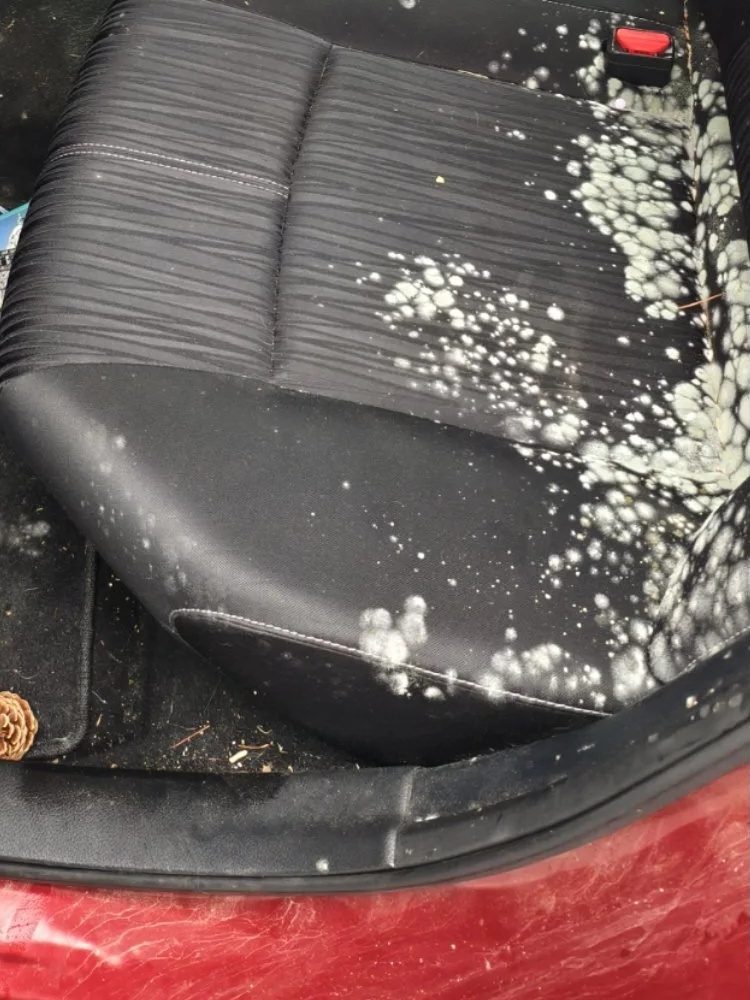
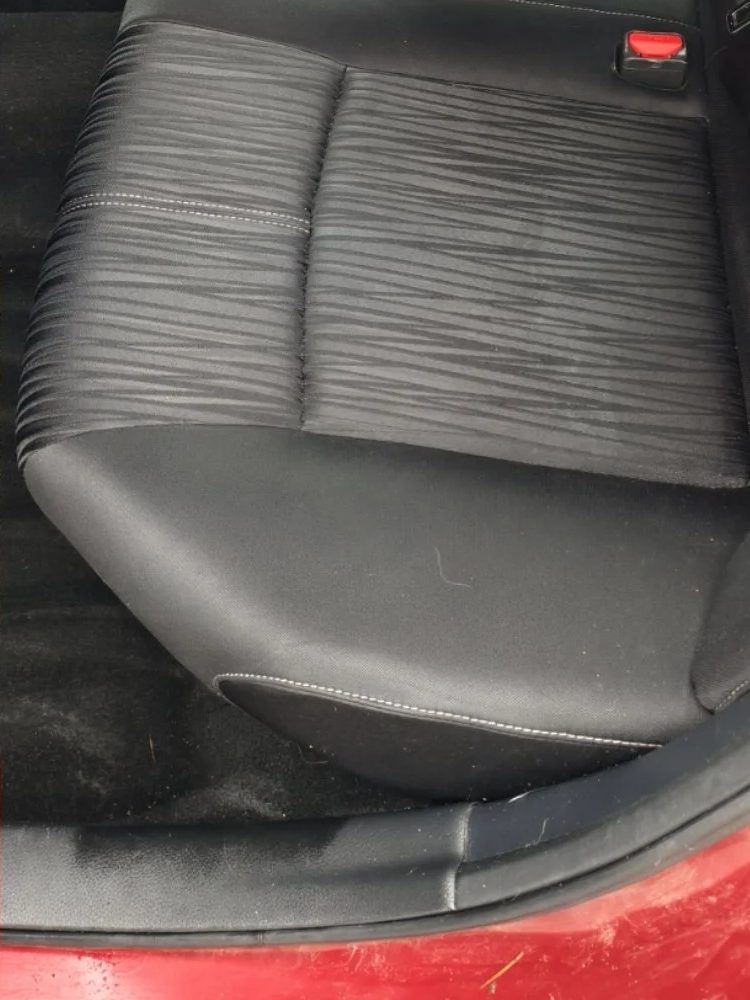
The rear seat and door panel of a black sedan, with white mold spots across the cushion and loose debris and a license plate frame left on the seat. Rear seats are rarely checked, so growth can build for weeks. We clear the area, HEPA vacuum, steam and extract the cushion and door panel, then apply Concrobium and ozone. Damp rear cushions often come from wet gear or a cracked window.
 Before
 After
Black Cloth Seat — White Speckles
A black cloth seat with white mold speckles, with the red car body visible below the window. Speckled growth is an early-to-middle stage that is easier to treat than a spread-out bloom, so it is a good time to call. The fabric is steamed and extracted, treated with Concrobium and then ozone. In Margate a few damp weeks in the wet season are often enough to produce it.
 Before
 After
Floor Mat — Heavy Colony Growth
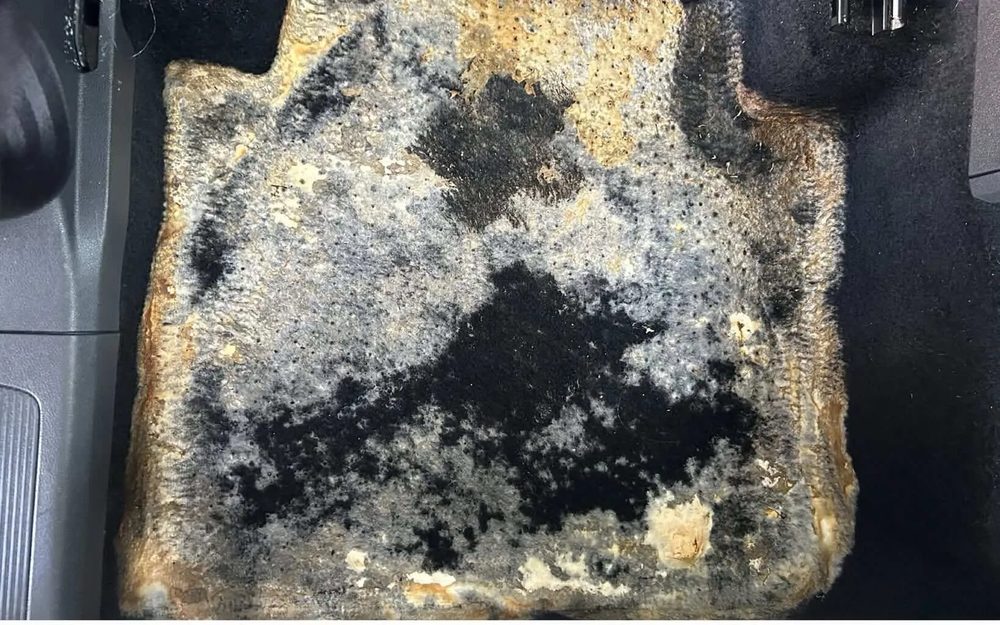
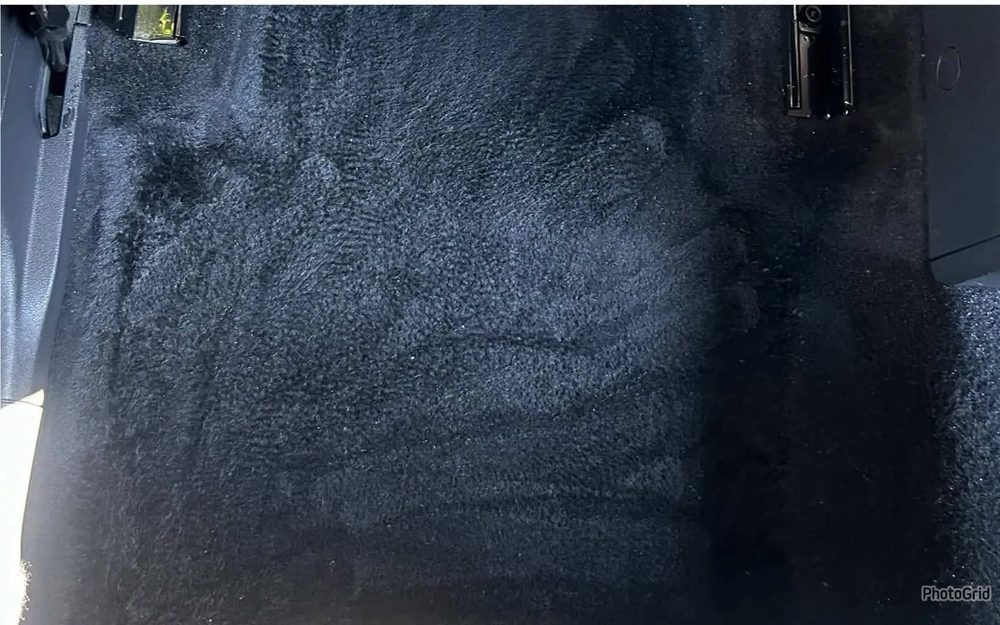
A carpeted floor mat with heavy black, brown and white mold colonies. Floor mats and the carpet beneath them hold water longest, so they are often the worst-hit area and the place where mold starts. We remove the mat, HEPA vacuum, steam and extract the carpet beneath, apply Concrobium and finish with ozone. Wet shoes, rain and a damp footwell are the usual feeders in a humid place like Margate.
100% Satisfaction.
Written. No exceptions.
If the result doesn’t meet our standard, or yours, we come back and redo it at no charge. No forms to fill out, no arguing over what “counts.” The guarantee is in writing before we ever touch your vehicle.
Request Mold Removal in Margate · From $549
Fill this in once and send it. We get your address, vehicle, and the situation all in one message, no phone tag.
Rating
Detailed
Response
Three steps from musty to clean,
and we handle the carport, the drive and the details.
No drop-off. No waiting. We come to Margate.
We come to you in Margate,
from the Margate Boulevard corridor to Winfield and Southgate.
Mobile service: home, office, condo, or marina. No drop-off, no travel fee.
Not seeing your city? Ask us — we likely cover it.
Open carports let blowing rain in sideways,
and Margate's humid air keeps the cabin from drying.
Margate sits about 13 feet above sea level and 7.5 miles inland, with some 30 miles of canals in the city, so humid air is a constant and an open-sided carport only keeps off the rain that falls straight down. Left untreated, what starts as a musty smell becomes a real health issue for the next person who drives the car. DShine's Concrobium Mold Control and ozone process address the cause, not just the symptom, backed by $2M insurance and a written guarantee. Mold doesn't need much to get started, any trapped moisture inside a closed cabin is enough given South Florida's humidity. The source is almost always one of four things: a clogged AC condensation drain letting water pool silently on the floor pan, a failed door or window seal letting rain in, a clogged sunroof drain, or the car simply sitting unused for two or more weeks without the AC running. In Margate the cause we meet most is not a sealed garage but an open carport: rain blown under the roof through a window or sunroof left a crack open, followed by damp carpet that stays damp in the shade.
Margate neighborhoods we serve,
from Oriole to Southgate and Lake Margate.
Parks, golf, lakeside streets and the Margate Boulevard corridor: how each part of Margate shapes mold risk and how we work there.
Margate Boulevard & State Road 7 — The city's main crossing and the focus of its redevelopment plans, with shopping plazas and workplaces around it. Many cars here are parked in open lots for long shifts, so we often treat them at a workplace and need permission from the property manager. Sun-heated cabins and A/C cycles add condensation.
Royal Palm Park & Calypso Cove — Home to the city's waterpark and a lake with a fishing dock at 6200 Royal Palm Boulevard. Streets and lots near a busy park mean cars parked outside for long stretches, and wet swim gear, towels and sandy shoes often end up on the floor. We work from your driveway or carport and keep things out of the way.
Firefighters Park & Rock Island Road — Firefighters Park on Rock Island Road has tennis courts, a dog park and a half-mile trail, so cars around it see sweaty gear and park-day dampness. Where two cars share a carport and driveway, we plan the visit around how the vehicles are laid out and which one has to move first.
Oriole Golf & Tennis Club Area — The Oriole Golf & Tennis Club sits at 8000 W Margate Boulevard, and the city also has an Oriole Park on NW 1st Street. Cars around a golf and tennis club are often parked for hours in the open, and damp towels and gear can end up in a closed cabin. We treat at your address and arrange access in advance.
Winfield Park & Winfield Boulevard — Winfield Park, at 6400 Winfield Boulevard, is one of the city's smaller neighborhood parks. In the blocks around a park like this, cars sit outside on driveways and under carports, so the main risks are blown rain through a window gap and wet mats. We work from your driveway or carport.
Southgate — Southgate Park on SW 64th Avenue and Southgate Boulevard mark the southern side of the city, which uses ZIP code 33068. Cars on these streets share the same humid conditions, and a shaded carport can keep a damp cabin from drying. We come to your driveway, confirm the layout and plan around other vehicles.
Lake Margate & Lemon Tree Lake Park — Lake Margate is one of the city's named lakes, and Lemon Tree Lake Park sits at 426 Lakeside Drive. Near open water, driveways and shaded carports can stay damp after storms, and a cabin that dries slowly holds moisture longer. We treat the car where it parks and tell you about any moisture source we see.
Don't see your area? Ask us — we likely cover it.
Margate car mold,
the carport questions we hear most.
Tap any topic to read the full breakdown.
Margate covers roughly 9 square miles about seven and a half miles inland from the Atlantic, at an elevation near 13 feet, with some 30 miles of canals running through its tree-lined streets. Climate normals for the area (NCEI, 1991 to 2020) put rainfall near 61 inches a year, and September, at about 8.3 inches, is the soggiest stretch of a wet season that runs May through October.
The number that matters most for a parked car is the dew point. In August it peaks around 75 degrees F, so on a typical summer night the air around your carport is humid enough to leave water on anything cooler than it is: glass, a steering wheel, a metal door sill. January lows sit near 59 degrees, which is gentle, but a cabin that went into winter damp keeps that moisture with it.
Weather alone does not grow mold; an interior that stays wet for a day or two does, since spores can wake up within 24 to 48 hours. In Margate the trigger is rarely one dramatic flood. It is repeated small doses: a soaked mat, a window cracked against the heat, an A/C that never gets time to dry itself, week after week.
Families come first. Margate has a waterpark, a golf club and a long list of neighborhood parks, and the cars that serve them carry wet swimsuits, cleats, sandy sneakers and half-finished drinks. Growth usually starts at the back: the footwell behind the driver and the carpet under a bench seat, places nobody reaches with a rag.
Retirees are the other large group. A little over one resident in five is 65 or older, and a car that makes three short trips a week, to the store, the clinic or church, never runs long enough to dry itself out. Cloth seats give it away first, with pale speckles along the seams, usually in late summer.
Last come the working vehicles: rideshare cars, delivery vans, contractor pickups. Wet boots, cooler runoff and grocery bags soak into liners and carpet, and the owner cannot spare the vehicle for long, so we plan the work as one block of three to four hours at your address.
Open carport beside the house: a roof and nothing on the sides, common on older homes in the city. It keeps straight-down rain off the windshield, but wind-driven storms push water in sideways, and a window cracked even an inch lets it reach the seat. Air moves freely, so a dry cabin stays dry. A wet one can stay wet for days, because the same roof blocks the sun that would help it dry.
Carport with a back wall, shutters or storage along one side: this is where a carport starts acting like half a garage. The breeze that would have dried the floor mats slows to nothing, the space turns shaded, still and humid, and there is no door seal to keep rain out. Cars that sit here for weeks with the A/C off are the ones we see with growth along the lower door panels.
Driveway with no cover at all: sun dries a cabin faster, which helps. It also heats a closed car enough to push any trapped moisture back into the cabin air, so the first blast of A/C can feel clammy. The real risks here are the cracked window, the sunroof seal and the door gasket that has hardened with age, rather than stale air.
Closed garage or shared lot: where a house has a garage, it brings back the opposite problem, a cabin sealed in with no airflow, and the rarely moved second car is the one we end up treating. In apartments and shared lots, we first ask whether we can set up in your assigned space, since the property manager decides what work is allowed.
Late May to August, when the wet season sets in: storms arrive most afternoons and carports take them sideways. This is the stretch where a window left open a crack, or a door not quite latched, turns into a wet seat. People also travel in summer, so a damp cabin often sits closed for weeks afterward.
September, the soggiest month: around 8.3 inches of rain on average puts water on curbs and low driveways, and mats soak up what wet shoes and dripping umbrellas bring in. Storm activity also peaks about now, so cars get shuffled and shut up quickly ahead of a forecast.
October and November, the tail end: rain eases, but the ground, the carport slab and the carpet under your mats are still wet from September. An interior shut up damp in early fall tends to smell by Thanksgiving, which is when plenty of owners finally pick up the phone.
December to April, the drier months: lower humidity slows growth and people leave windows open on nice days, so mold is less likely to start new. What shows up now is the leftover from summer: padding that never fully dried, vents that carry a sour smell when the heater or A/C first comes on, and cars that sat during winter trips.
Most appointments unfold under a carport roof or on a driveway slab, which suits the equipment well. What we need is reasonably flat footing, clearance to swing each door fully open, and a protected corner where the vehicle can remain sealed through the ozone stage. A storage wall, a shed or a second car in the bay is workable; a quick phone photo of the layout lets us stage everything in advance.
Weather is the one variable a carport cannot manage. When thunderstorms are forecast across your appointment window, we would sooner agree on another slot than open doors in windblown rain, because a dry floor and still air give the extraction and drying stages their best result.
Renters should confirm with the landlord or property manager where work is permitted. The city keeps a rental property registration program, and its commission has debated limits on parking across front-yard grass, so check the current rule if the second vehicle lives on the lawn. At a workplace lot, the lot manager decides.
1. Rain through a gap under an open carport: a window left down a crack, a sunroof not fully closed or a door ajar, and a wind-driven afternoon storm does the rest. The seat bolster, door panel and carpet on the exposed side take the water, and because the cabin is shaded it stays wet longer than a car in the open sun.
2. Wet floor mats that never fully dry: the commute, a rainy morning, kids, a pool day. Water settles in the carpet padding under the mat, where nobody checks. A rubber mat can trap that moisture against the carpet, and a cloth mat holds it like a sponge. Mold starts under the surface and shows up later as a sour smell.
3. A cabin that sits with the A/C off: a car driven twice a week, or parked while the owner travels, never gets its evaporator box dried by regular use. A blocked evaporator drain makes it worse. The first sign is a sour whiff in the opening half-minute after you start the car, and the vents often turn out to be involved.
4. Tired seals and standing water: years of Florida sun harden rubber gaskets, so an older car stops sealing against rain while it sits, and the water trickles into the footwell instead of pouring in. A heavy downpour can also pond water at curbs and low spots, and a car that sits in it picks up damp carpet without ever being a flooded car.
Bookings typically open with three or four phone photographs, the worst patch, the entire seat and the footwell, sent by text or WhatsApp. A first tier comes back in roughly two minutes. When we arrive inside your window, we examine the vehicle alongside you and fix the exact price before any bottle is opened.
The full eleven-step sequence follows, from the HEPA vacuum to the final check, and the carport mainly decides where each machine is staged; a shaded slab is a pleasant place for a steamer in August. Plan on three to four hours. You may be at work throughout, provided we can reach the vehicle.
By afternoon a set of before-and-after photographs lands in your WhatsApp. If the visit exposed a probable cause, such as a perished door gasket or a blocked evaporator drain, we say so aloud, so the vehicle does not roll straight back into identical trouble.
Cost is the opening question, and the answer is brief: $549 when growth is confined to one place, $749 when it has spread throughout the vehicle. Travel is built into both. No one quotes a final figure sight unseen; we confirm it after reviewing photographs or your description, always ahead of the work.
Next comes whether a garage is required. It is not. A driveway slab, an open carport or a space in a communal lot all work, provided the footing is reasonably level and the doors can swing wide. Carport owners tend to apologise for the structure; there is no need.
Third is dread that the odor will creep back. For 30 days, if mold or the musty smell returns, we treat the vehicle again at no charge, in writing. We also name any leak, gap or sluggish drain we spot, since a freshly cleaned interior parked beside the original culprit invites a repeat.
Under an open carport the paint takes a beating from sun, bird droppings and leaf litter, so Paint Correction is the add-on we hear about most. If the interior is already getting a deep clean, many owners would rather fix swirls and faded clear coat in the same appointment than book twice.
Ceramic Coating is the follow-up for people who have just paid to restore the inside and want the outside shielded from the same weather. Engine Bay Cleaning is a smaller extra, usually for older cars with a lot of daily mileage. We will say what is worth it once we have seen the car.
Two neighbouring services are separate from mold work. Odor Removal Detailing, $349, suits a stubborn smell from food, smoke or spills with no mold behind it. Flooded Car Detailing, also $549, is the fast response for water that got into a cabin in the last 72 hours, aimed at stopping mold before it begins.
Try this beneath your carport roof: lift the driver's mat and press a dry paper towel against the carpet for ten seconds. A towel that comes away clammy means the padding underneath is retaining water, and padding is precisely where Margate vehicles begin cultivating mold, long before any surface evidence.
Next, study the glass and the stitching. A hazy film on the inside of the windshield that reappears after wiping suggests humid air or microbial growth inside the vehicle. Powdery pale speckles, or gray-white bloom, along cloth seams, across the dashboard or on the steering wheel mark early surface colonies.
Finally, consider how you feel. Sneezing, coughing or itchy eyes that ease once you step outside are worth documenting with a photograph. Medical guidance is beyond our remit, yet eliminating the colonies and purifying the air is exactly our work.
Margate's characteristic idle pattern is a vehicle that moves once or twice weekly, rather than one mothballed for months. A spare sedan, a retiree's runabout or a hybrid-schedule commuter never completes a full drying cycle, so supply one: ten to fifteen minutes of A/C on the fresh-air fan setting, every few days.
Resist cracking windows to bleed off heat. It seems harmless, but a single afternoon thunderstorm with wind from the wrong quarter soaks the upholstery. Park with every window and the sunroof fully closed, and deploy a reflective sunshade against the heat instead.
Remove anything damp, and confirm that rubber floor liners are not pinning water against the carpet. For an extended layover, a small desiccant tub on the floor adds a margin, supplementing a dry interior rather than substituting for one.
Numerous Margate households run two or three drivers from a single driveway and carport, so the vehicles seldom share the same condition: one is the daily workhorse, another the car nobody fancies driving. Each is priced from its own photographs, $549 or $749, depending on its interior.
When several vehicles need attention we can sequence them within one visit rather than scattering the work across days. Describe how they are parked, because two cars nose to tail beneath a carport dictate which must be moved first. A snapshot of the layout settles it.
Rotate drivers where possible. The car used daily dries itself; the one dozing in shade needs a brief A/C run and a mat inspection as the rains return. And if one vehicle carries mold, examine its neighbor, since damp gear migrates between cars.
The pledge is plain and printed: for 30 days after the visit, should mold or the musty smell resurface, we return and treat the car again at no charge. It covers what you hired us to eliminate, namely visible growth and mold odor, instead of hiding behind a long list of exclusions.
Beneath an open carport the usual reason trouble resurfaces is that the original cause persists. A window that will not quite seal, a hardened gasket, a drain that still backs up, or a floor mat returned over soaked carpet quietly rebuilds the problem. When we notice one, we flag it before we leave.
Discussing it on site, plus the WhatsApp photo record, means you never wonder how the interior looked when we departed. Should a spot reappear within the window, send a fresh picture; we compare it with that record, and the return visit costs you nothing.
Aging vehicles are everywhere in Margate, and age cuts two ways. Rubber gaskets harden after years of sun and admit rain more readily, while carpet padding in an older car can retain moisture deep within the foam. We inspect both, and we say so before work begins if padding or a headliner is beyond reliable treatment.
Leather and wood trim receive the leather-safe protocol, which cleans without stripping or desiccating the finish. A costlier car is not scrubbed harder; it is handled more gently, with identical photos and the identical guarantee. A powdery bloom on a leather armrest merits early action.
Work vehicles are a separate matter: a contractor's pickup or a delivery van gathers wet tools, tarps and food in its bed liner and carpet. If you need it back for the next shift, mention it when booking and we will plan around the three-to-four-hour window.
Dry first: pull the mats, press the carpet underneath, and if anything feels cool or clammy, leave the doors open on a breezy, sunny day until it is dry. Towels, umbrellas, swim bags and takeout cups all leave the car before it is locked.
Shut fully: every window and the sunroof, even under a carport. A gap that looks harmless in January is exactly how a September storm gets in, and a carport roof will not stop sideways rain.
Run the air: on the last few minutes of your final drive, press the A/C button off and keep the fan blowing so the evaporator dries. Gone for more than two weeks? Ask a neighbor to start the car and run it once while you are away.
Settle open questions: a musty note, a fogged windshield or fresh speckles deserve attention before you go. A cabin closed with mold already inside only gets worse, and a photo sent to us is enough to say which tier it would be.
A blemish you could cover with your palm today can be far larger by August. Mold propagates through carpet, padding and ductwork across warm, wet months, and a $549 single-zone job can slide into the $749 tier once colonies are distributed throughout the vehicle. Acting early generally costs less, not more.
Then there is the car's own worth. Mold reaching leather, upholstery or trim may leave blemishes that treatment contains but cannot always erase, and a musty vehicle is harder to trade in, sell or return at lease end.
And there is daily exposure: every commute spent inhaling recirculated air that carries spores. A small patch caught early is no cause for alarm; it simply means that hoping a humid-season smell fades unaided seldom pays off in Margate.
With a median age near 44 and roughly 21.5 percent of residents aged 65 or older, Margate is full of cars making a few brief trips weekly. A vehicle like that seldom runs long enough to dry its own air-conditioning, so the evaporator and ductwork stay moist between outings.
The signature is a faint sour whiff in the opening seconds of A/C, a veil on the inside of the windshield, or speckling along seat seams. Owners dismiss it as an old-car odor and learn it was mold only when a passenger sneezes or remarks on it.
A modest routine helps between treatments: one longer drive weekly, fifteen minutes minimum with the A/C running, and dry floor mats. If the car mostly rests, tell us where it lives and who holds the key, and we can arrange access through a relative or a building manager.
Two tiers hinge on one question: how much of the vehicle is affected? Mold in a single zone, such as one seat, one door panel or one row of carpet, is $549. Mold distributed throughout the vehicle is $749. Travel to your Margate address carries no surcharge in either case.
Your photographs or description yield a first read in about two minutes, but the figure becomes final only after we inspect the vehicle at your address. We settle it with you, aloud, before any product leaves the van, so the number you accept is the number you pay.
A car in better shape than the pictures implied receives the lower tier. A worse one is flagged at the outset, never midway through the work, so you decide with the complete picture and no invoice swells while the steamer runs.
Roughly 61 inches of annual rain, a wet season stretching from May into October and countless cars sheltered by open-sided carports make a waterlogged interior likelier than owners suppose. Most cases begin with a soaked mat, a window gap or an A/C that never dries, rather than a flood or a leak.
We travel to the driveway, carport or workplace lot and treat the vehicle in eleven steps built around Concrobium and ozone, typically across three to four hours. One zone is $549, the whole vehicle $749, travel included, and the exact amount is confirmed before work starts.
IDA certification and a written 30-day guarantee stand behind the work, and a WhatsApp photo set keeps the result on record. If a carport car is hinting at mustiness right now, Margate's damp months are the wrong time to wait it out.
Once the surfaces have been steamed, extracted, dried and treated with Concrobium, the car is closed up and an ozone generator runs inside. Unlike a wipe or a spray, ozone travels through the air, the vents and the fabric, and breaks down what causes the smell instead of covering it with perfume.
No one stays in the vehicle for the cycle, and we ask the household to keep clear of the car and the doors until we say it is finished. At a carport we leave a note on the glass and keep kids and pets away from that corner of the property.
Afterward the doors open and the cabin airs out fully before anyone sits down. An open-sided carport is a good spot for this, since breeze clears the air quickly. We tell you when the car is ready, then finish with the Meguiar's odor treatment and the last inspection.
Before you book,
answers for Margate drivers.
Add-ons Margate clients book
Still deciding? Read: the complete mold removal guide · does insurance cover it? · why DIY mold removal fails.
Mold in your Margate car? Get a price in under 2 minutes.
Serving Margate and all of Broward County. Fixed pricing, no travel fee. We confirm in under 2 minutes.
It Might Just Be an Odor Problem
If there's no visible mold growth yet, the smell alone is usually an Odor Removal Detailing case ($349 flat) — faster than full mold remediation ($549–$749). See which one matches what you're dealing with: