What a North Lauderdale Mold Job Includes
This is not a car wash. Car Mold Removal uses Concrobium Mold Control treatment, pH-balanced products, and machine assistance, the same process used in pre-sale preparations for luxury dealerships.
Why it matters for your health: Mold in a vehicle is a different exposure than mold on a wall at home. With the AC recirculating, everyone inside is breathing concentrated spores for the length of the drive. The EPA and CDC both link mold exposure to respiratory irritation, allergic reactions, headaches, and worsened asthma symptoms. Children, older passengers, and anyone with a compromised immune system typically react faster and more severely than a healthy adult would. By the time the smell is noticeable, spores have usually already spread through the HVAC system into every vent in the cabin.
Curious what actually happens during the visit? Tap through our real 11-step process below to see what we do at each stage and why it matters.
What a flat price gets you on every North Lauderdale mold job
Most detailers in North Lauderdale charge less. Here’s exactly what you gain — and what you risk — with each choice.
| DShine DetailsFrom $549 · travel included | Avg North Lauderdale Detailer$149 – $199 | |
|---|---|---|
| Industry certificationsIDA, Koch Chemie, Meguiar’s, 3M, Symplex, XPEL | ✓6 verified | —0 credentials |
| $2M liability insuranceWe cover any damage — in writing | ✓ | —Often uninsured |
| Deionized water systemZero mineral residue, no water spots | ✓ | —Tap water, water spots |
| Fresh microfibers per vehicleNo cross-contamination between jobs | ✓ | —Shared towels, swirl risk |
| Mold-specific chemistry onlyConcrobium, Benefect & Meguiar’s, no harsh acids | ✓ | —Industrial degreasers |
| Before & after photosSent via WhatsApp on completion | ✓ | —No documentation |
| 100% written satisfaction guaranteeReturn & redo at no cost if unsatisfied | ✓ | —No written guarantee |
| Travel to your address — $0Home, office, condo — no drop-off | ✓ | Sometimes adds fee |
DShine vs. any other detailer
in North Lauderdale, Broward County
Three things most detailers won't tell you. We put them in writing.
 Since 2018
With more than 20 years of hands-on experience in the automotive care industry, Evelio launched DShine Details in August 2018 with one van and zero shortcuts. For the first six months he slept in the van to keep costs down and standards up. Today DShine runs 7 certified vans across Miami-Dade, Broward, and Palm Beach, and the commitment hasn't changed. Every vehicle is treated as if it were his own.
What clients say
in their own words.
Before & After: Mold Removal We've Actually Done
No stock photos. These are real DShine mold removal jobs across South Florida, the same 11-step process and chemistry used on every North Lauderdale appointment.
 Before
 After
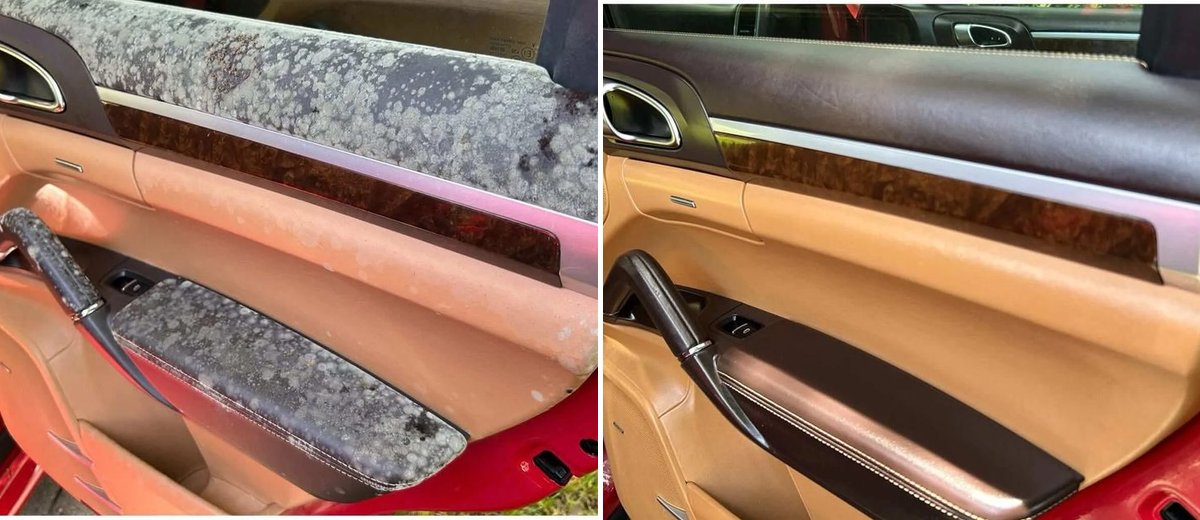
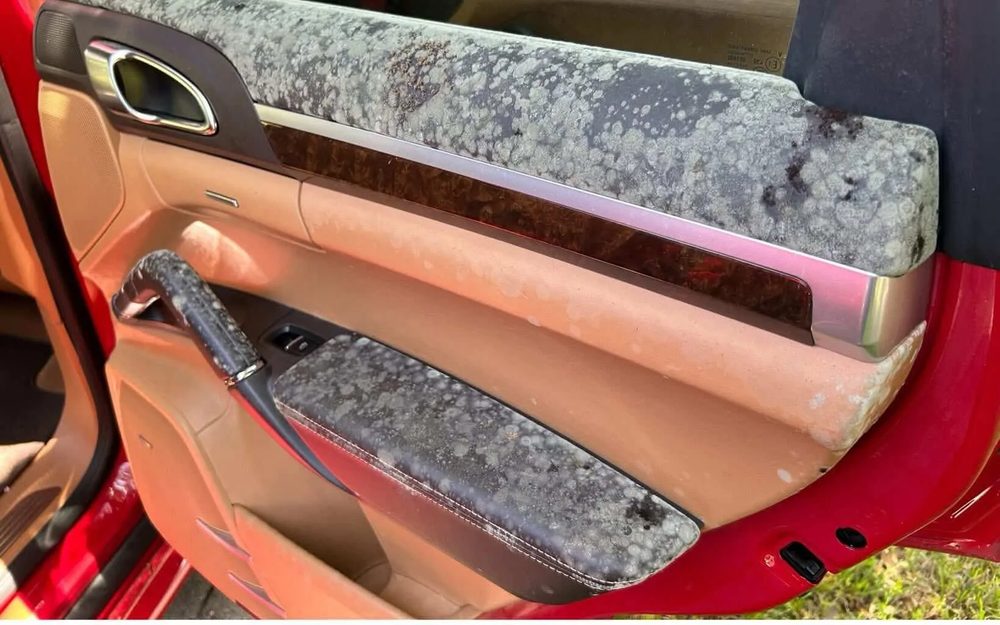
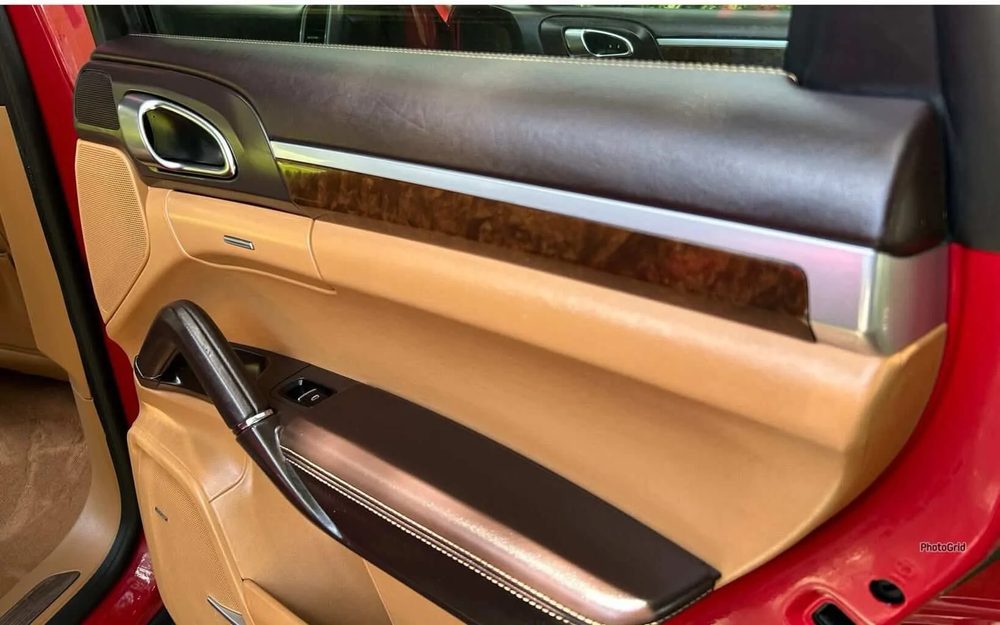
Porsche Cayenne — Door Panel & Armrest
Mold across the tan leather door panel and armrest, running up to the wood trim, with the red body visible beyond. Leather like this gets the leather-safe protocol: controlled steam and extraction, Concrobium on the surface and ozone for the cabin air, so the finish is not stripped. Closed-up, damp cabins are a common cause of this pattern in North Lauderdale's wet season.
 Before
 After
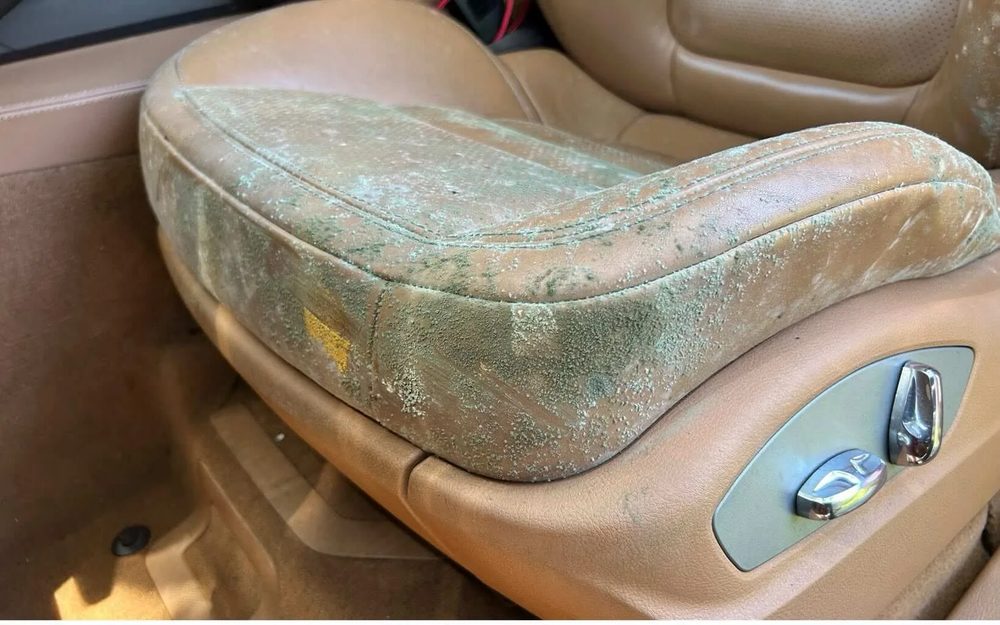
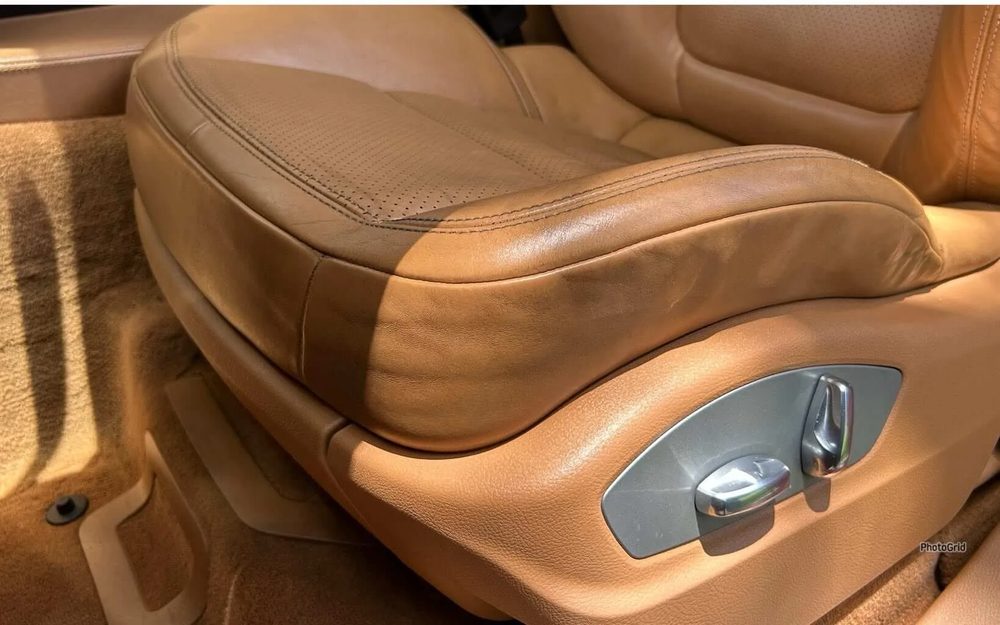
Leather Seat — Green-Blue Mold
Green-blue mold growing over the bolster of a tan leather front seat, the part that rubs against clothing every time someone gets in. We lift the growth with a leather-safe cleaner, treat it with Concrobium and use ozone to reach the foam underneath. Leather that stays humid after a wet commute and a shut cabin is a pattern we see across Broward summers.
 Before
 After
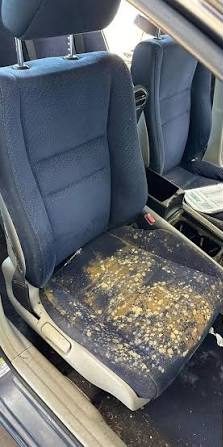
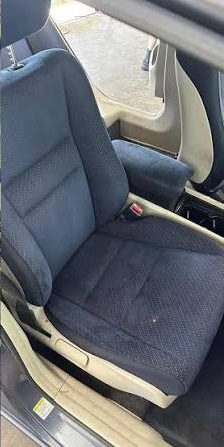
Cloth Bench Seat — Stain Residue Underneath
The seat cushion of a dark blue cloth sedan lifted to show tan and yellow mold-stain residue on the underside. This is the hidden side of mold, because the top can look fine while the damage sits underneath. We steam, extract and treat both sides with Concrobium. A spill that soaks through the cloth and never fully dries is a typical cause of this pattern in a car that is used every day.
 Before
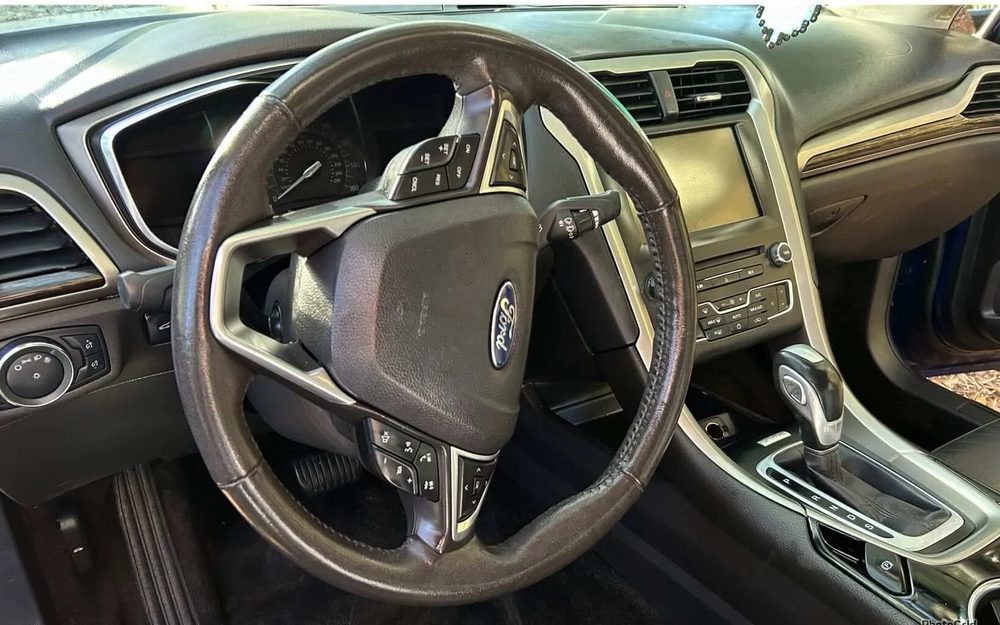 After
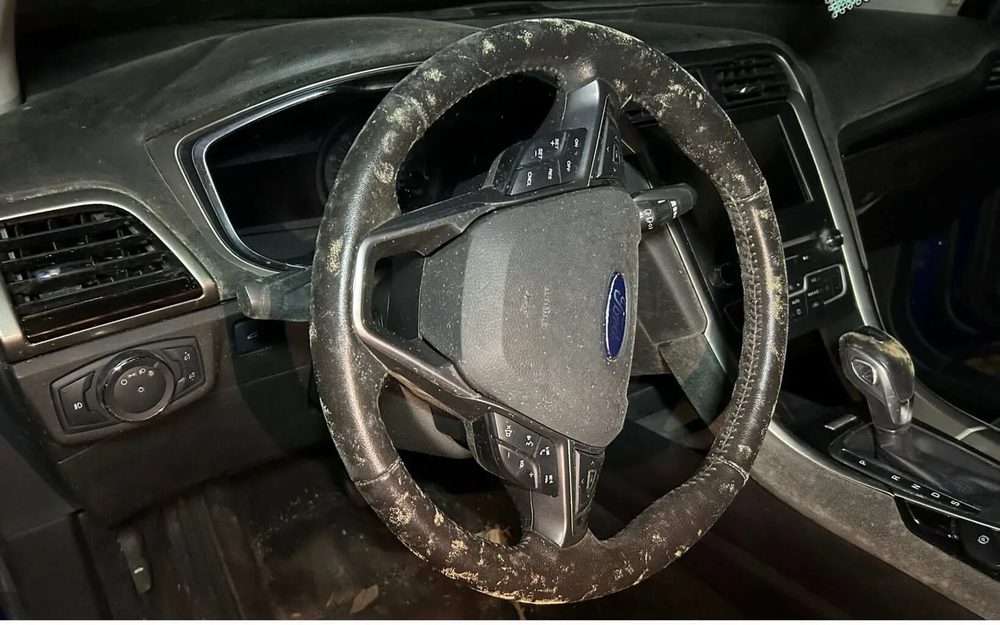
Steering Wheel, Dash & Vents — Grey-White Bloom
A grey-white mold bloom across the steering wheel, dash and vents of a Ford sedan, the surfaces you touch and breathe near. We clean hard surfaces by hand, steam them, treat with Concrobium and use ozone to reach the vent passages behind the dash. A cabin that stays shut and humid for long periods between short drives is a common source of this pattern in North Lauderdale.
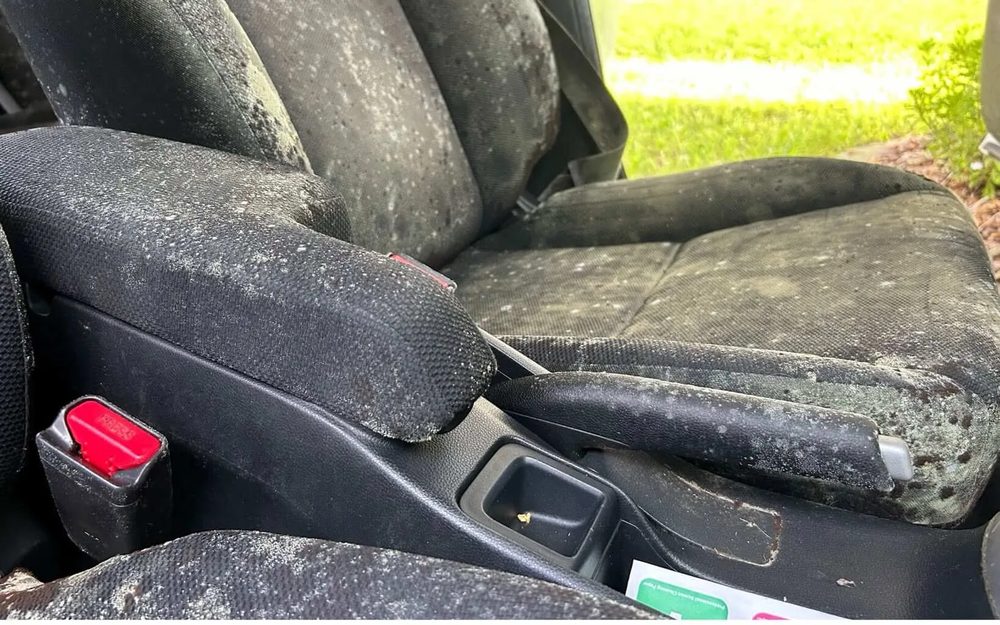 Before
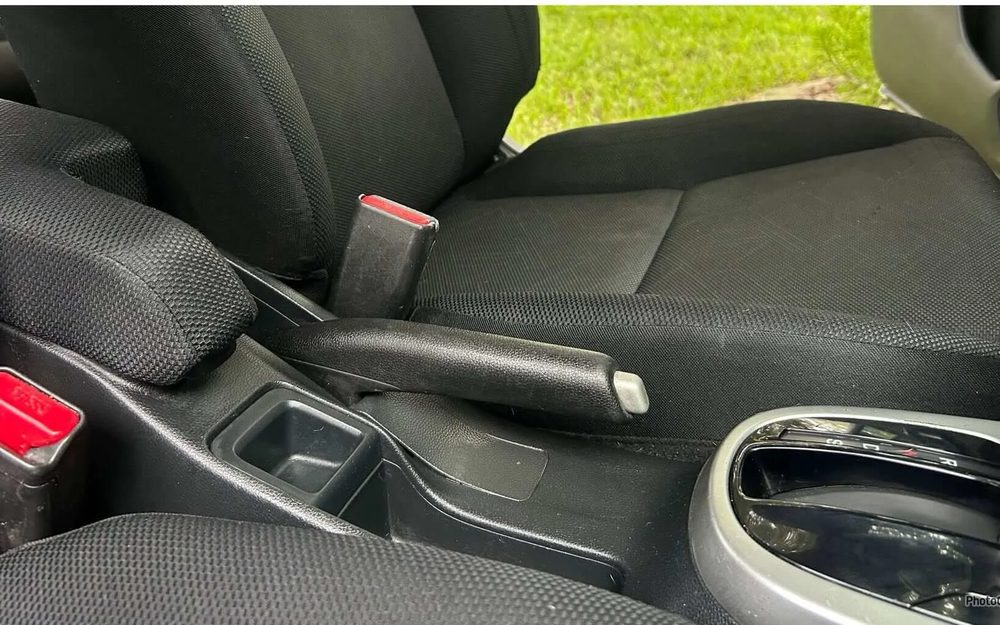 After
Cloth Driver Seat & Console — Mold Bloom
Grey-white mold bloom across a black cloth driver seat, the armrest and the console, with a green lawn visible outside the window. Fabric holds moisture, so we use steam and extraction to pull it from the foam, then Concrobium and ozone. Humid air in a parked car after a wet day, with the lawn sprinklers and rain outside, is a common way this builds in Broward.
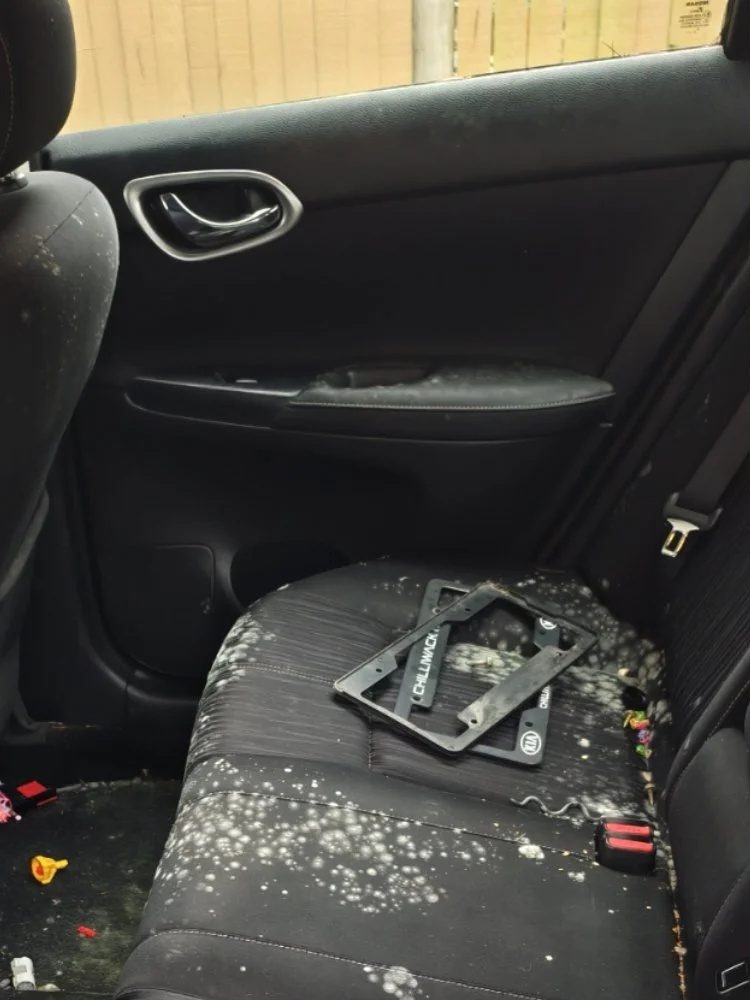 Before
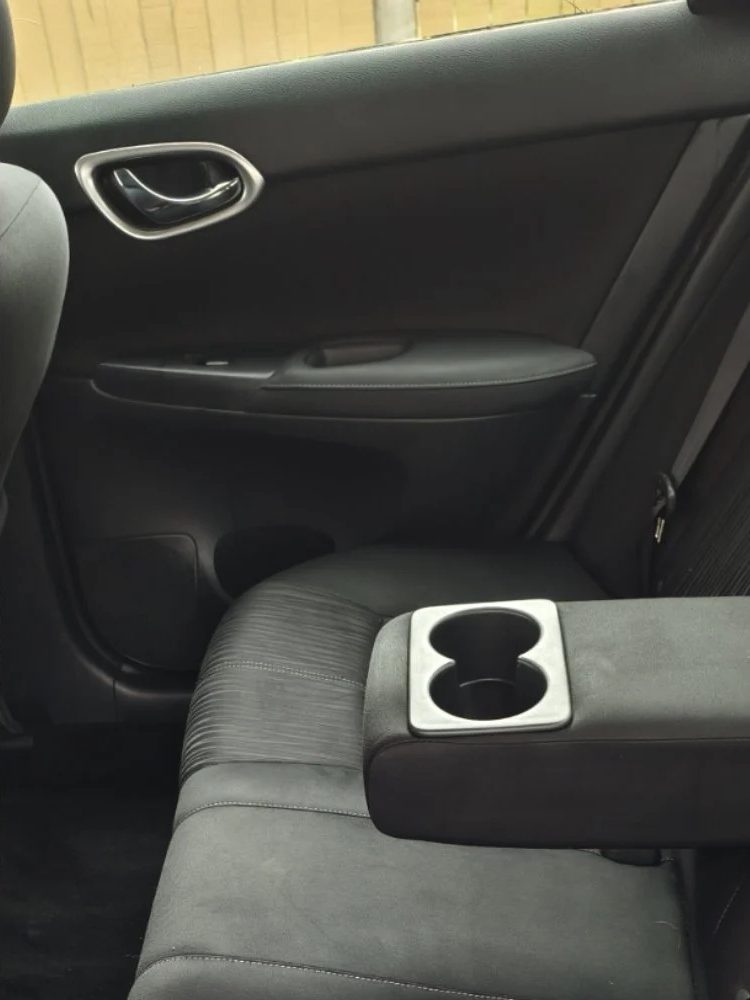 After
Rear Seat & Door Panel — White Mold Spots
White mold spots across the rear cushion of a black sedan, with loose debris and a license plate frame left on the seat. The rear seat is often forgotten, which gives mold time to spread. We clear it, HEPA vacuum, steam and extract, then treat with Concrobium and ozone. Back seats that get wet gear and spilled drinks are a frequent cause of this pattern in a daily-use family car.
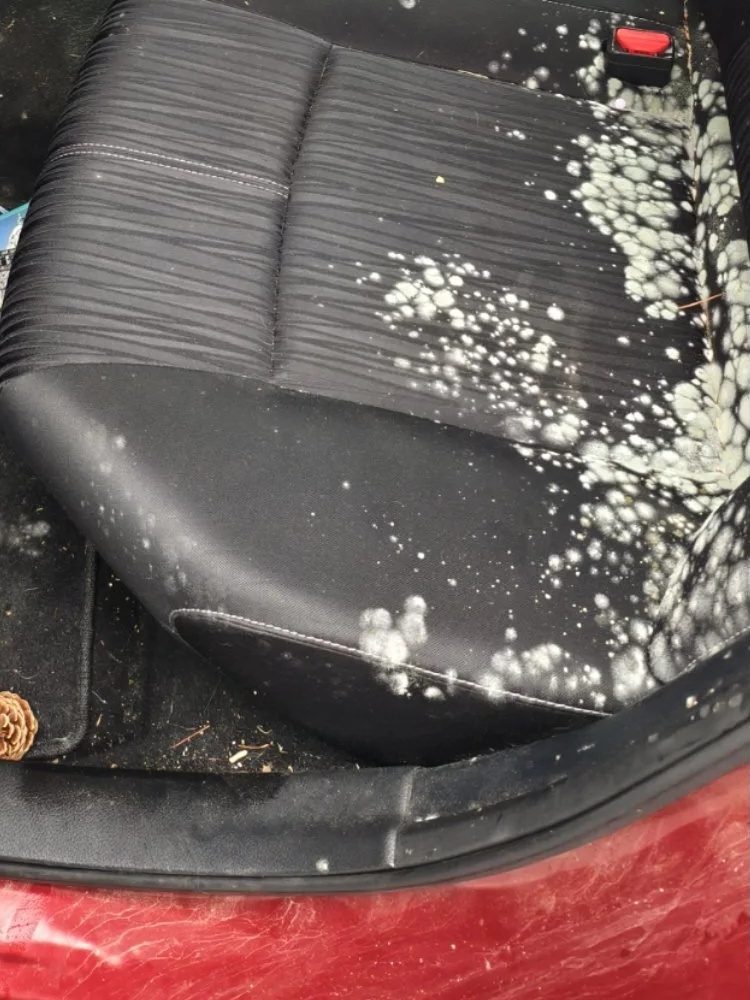 Before
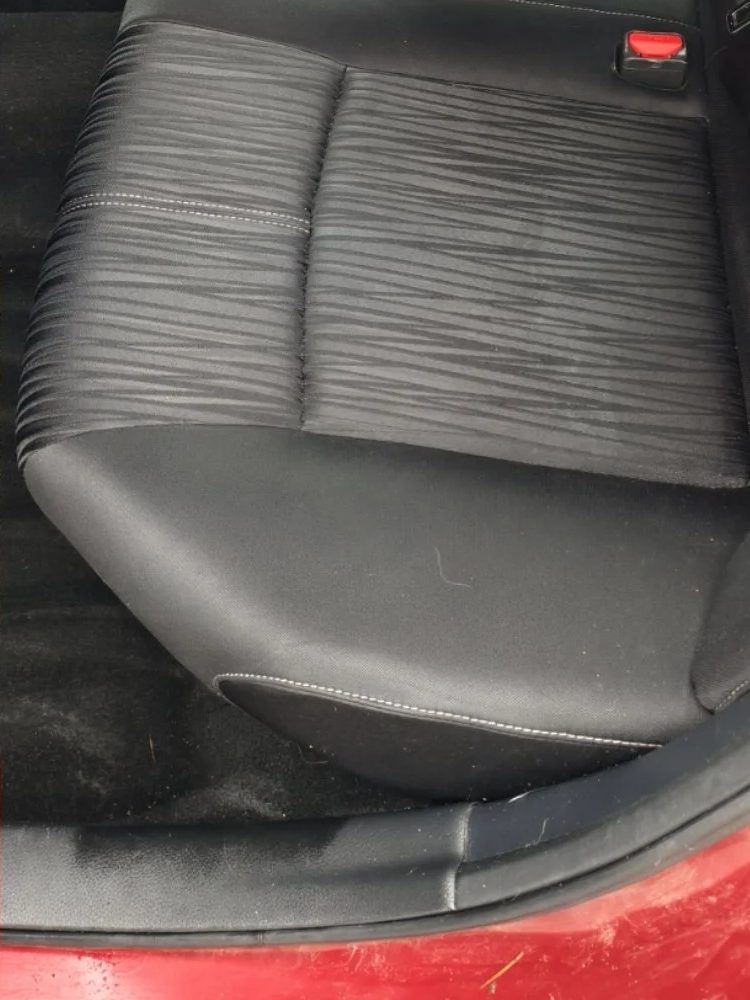 After
Black Cloth Seat — White Speckled Mold
Fine white speckles across a black cloth seat, with a red car body visible below the window. Speckled growth like this is the early stage, and treating it now is often the $549 one-area job. We steam, extract, apply Concrobium and run the ozone cycle. A seat that stays slightly damp from humid air or a window left cracked is how this usually starts in a wet summer.
 Before
 After
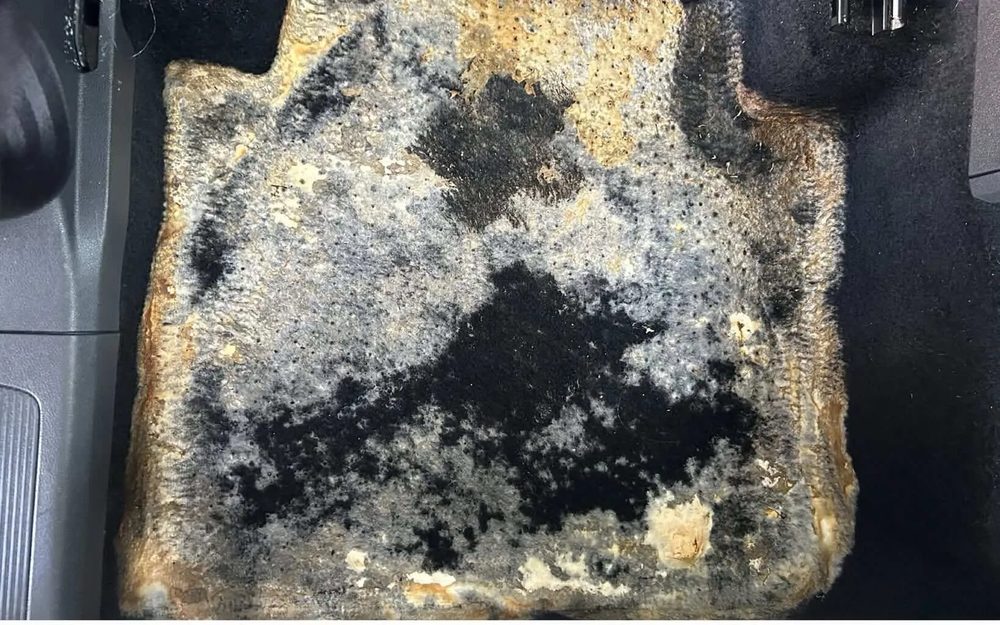
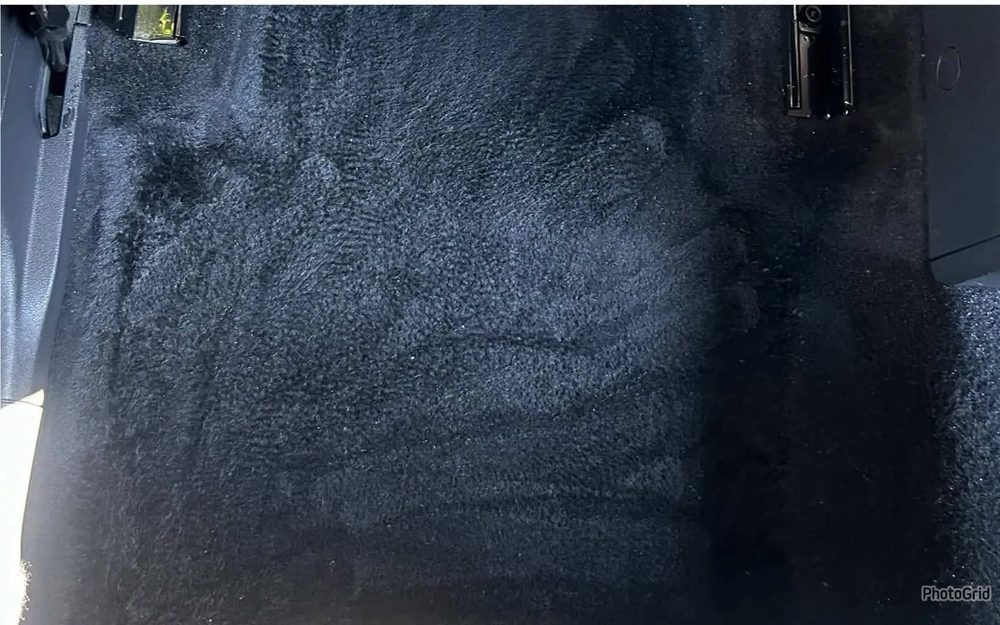
Floor Mat — Heavy Colony Growth
A carpeted floor mat with heavy black, brown and white mold colonies, the result of staying wet for a long time. Mats and the carpet pad beneath them hold more water than any other surface in a car, so we pull them out, extract, treat with Concrobium and ozone the cabin. Wet shoes and umbrellas on a mat that never dries are a frequent cause of this pattern in daily drivers.
100% Satisfaction.
Written. No exceptions.
If the result doesn’t meet our standard, or yours, we come back and redo it at no charge. No forms to fill out, no arguing over what “counts.” The guarantee is in writing before we ever touch your vehicle.
Request Mold Removal in North Lauderdale · From $549
Fill this in once and send it. We get your address, vehicle, and the situation all in one message, no phone tag.
Rating
Detailed
Response
Photos, a price, a visit,
and the rest is on us.
No drop-off. No waiting. We come to North Lauderdale.
We come to you in North Lauderdale,
from McNab Road to Southgate Boulevard.
Mobile service: home, office, condo, or marina. No drop-off, no travel fee.
Not seeing your city? Ask us — we likely cover it.
Daily-driver dampness, not dramatic floods,
the everyday mold problem of a North Lauderdale commute.
North Lauderdale sits about 10 feet above sea level, and with Broward's wet season running May through October, a car that is driven every day can still never fully dry out. Left untreated, what starts as a musty smell becomes a real health issue for the next person who drives the car. DShine's Concrobium Mold Control and ozone process address the cause, not just the symptom, backed by $2M insurance and a written guarantee. Mold doesn't need much to get started, any trapped moisture inside a closed cabin is enough given South Florida's humidity. The source is almost always one of four things: a clogged AC condensation drain letting water pool silently on the floor pan, a failed door or window seal letting rain in, a clogged sunroof drain, or the car simply sitting unused for two or more weeks without the AC running. Here the cause we meet most is not a car left alone but one used constantly: short trips, a damp floor mat that never dries, and an A/C drain that clogs quietly until the carpet is soaked.
North Lauderdale areas we serve,
from Hampton Pines Park to the SR 7 corridor.
From Hampton Pines Park to the SR 7 corridor: how parking, lots and everyday roads shape mold risk in each part of North Lauderdale.
Hampton Pines Park — The city's main park, entered at 7800 Hampton Boulevard off McNab Road, with a lake, trails, picnic areas and fishing. Cars here spend an afternoon with damp towels, wet shoes and cooler bags, then go home with them. Most of the mold we link to the park is a wet floor, not the park itself.
McNab Road — A main east-west road with shopping plazas, including the Promenade Shoppes at 7910 W. McNab Road. Cars parked here are in open lots with no cover, and errand drivers often leave wet items on the floor. We can usually meet you at home or at a workplace on this road, once the property agrees.
State Road 7 / US 441 — The busy commercial corridor along the city's edge, with shops, offices and service businesses. Many cars sit in open lots here for a full shift, baking in the sun and then cooling in the A/C. We treat vehicles at workplace lots when the employer or the property manager allows it.
Boulevard of Champions — A curving residential street known in the city's history for its unusual, amoeba-like shape. Homes along streets like this are mostly driveway and carport parking, so the key risks are rain on worn seals and wet floors. We ask which way the car sits and work in the driveway.
Southgate Boulevard — A through road in the 33068 ZIP with a mix of homes and commercial properties. Cars here park in driveways, lots and along the curb, with the mold risk set by how often a drain clogs or a seal fails. We confirm the exact address and parking before each visit.
Kimberly Boulevard — A road where both houses and condo buildings appear in property listings. The condo spaces mean uncovered shared parking, with no garage to dry out in. We ask for the building's access rules ahead of time and treat the car at its space so you do not have to move it.
SW 71st Avenue — Home to North Lauderdale City Hall at 701 SW 71st Avenue and the Riverside Square Shopping Center at 941 to 999 SW 71 Avenue. The surrounding area is mostly residential with a neighborhood shopping strip, so cars are parked at homes and in the plaza lot. We confirm the address and the best place to set up.
Don't see your area? Ask us — we likely cover it.
North Lauderdale car mold,
straight answers for everyday drivers.
Tap any topic to read the full breakdown.
Start with the map. North Lauderdale is a flat 4.62 square miles of land at roughly 10 feet above sea level, with hardly any open water inside its borders. The rain comes from the sky, not the shoreline. Fort Lauderdale-Hollywood International Airport, the area's long-record weather station, logs about 61 inches a year, and the wet season runs May through October. June is the soggiest month at about 9.5 inches, July the hottest at a 90.0 degree F average afternoon high.
What that means for a car is simple. The water arrives with you: a dripping umbrella, soggy sneakers, a cold drink sweating onto the console. Each trip adds a little, and a cabin closed up in the afternoon heat holds it like a steam room. Spores need only about 24 to 48 hours of those conditions to take hold.
Flat ground and big paved lots mean puddles linger around door sills after a downpour. Water creeps into door pockets and past tired seals, then drains down into the carpet. When the sun returns, the top layer feels dry and the padding underneath is still soaked.
Think commute and carpool, not showroom. The cars reaching us from North Lauderdale are mostly sedans and small crossovers with cloth seats, driven every weekday, and the complaint is nearly always the same: a smell that was faint in June and impossible to ignore by August.
Next come the family vehicles. The 2020 Census counted children under 18 in 43.8 percent of the city's households, and one kid's cup rolled under a seat can sit there for weeks. We often find growth beneath the rear bench, along the seat rails and inside cupholders instead of where the owner was looking.
After that, a small working fleet: pickups, vans and hatchbacks hauling wet boots, tarps and uniforms, plus older used cars whose seals and A/C drain were already worn at purchase. Different vehicles, one pattern. Water gets in with ordinary life, and the cabin never dries out again.
Driveway or carport at a single-family home: the most common setup here. Open air helps a car dry, but a carport roof can drip onto a worn seal, a driveway collects standing water after the afternoon downpours, and a vehicle parked under a tree stays damp longer because leaves keep the roof and window seals wet.
Closed garage: better against rain, worse for airflow. If the garage is also used for storage, boxes and a washer, humidity builds in there for days. A car parked inside right after a rainy commute, with wet mats and the doors shut, can stay damp longer than the same car left in the sun.
Apartment and condo lots: roughly four in ten homes in the city are rented, since 60.1 percent are owner-occupied, and condo buildings sit along roads such as Kimberly Boulevard. Cars in shared lots usually have no garage at all, so the cabin takes whatever the weather sends. We confirm access with you before we arrive.
Street, swale and work lots: all open to the air, and all open to sprinklers and heavy rain, which makes a window left open a crack an expensive habit. A car parked nine hours in a work lot, then driven home with the A/C on recirculate, traps the moisture the carpet gave off in the heat. That daily cycle is a common starting point.
May and June: the rains settle in and the afternoon downpour becomes reliable. Shoes, umbrellas and wet bags ride in the car daily, and a mat that is damp at 5 p.m. is often still damp the next morning. June averages about 9.5 inches at the airport station, so the carpet gets little time off.
July through September: heat plus humidity plus a shut cabin. A car baking in a work lot gives off the water its carpet is holding, then the A/C on recirculate keeps that moist air inside. The Atlantic hurricane season runs June 1 to November 30, and most activity falls between mid-August and mid-October, when wind-driven rain finds weak seals.
October through April: the dry season brings cooler, less humid weather. Owners drive with the A/C off and the windows up, and the cabin air stops moving. Carpet that was soaked in September can still be damp, so this is when many people first notice a smell and blame the cooler weather.
All year: the school run, sports practice and the commute never stop, so the wet gear never does either. The risk only changes in speed. A rainy week speeds it up, a dry week slows it down, but a carpet that already holds water keeps feeding growth in any month, and it is rarely dry for long.
A lot of North Lauderdale cars sleep in apartment lots, condo lots and shared parking, so access is the first thing we sort out. We ask where the car is parked, whether the property allows work in the lot, and whether the spot gives us room to open every door. Often a short message to the property manager is enough, and we tell you what to ask for.
For driveways at a single-family home, none of this matters. We park, set up beside the car and get started. For a condo or apartment spot, we look for a space where the car can stay undisturbed for the three to four hours the visit typically takes, and where the ozone step will not drift toward a door or walkway.
If your building does not allow service in the lot, a workplace parking space, a relative's driveway or any other safe address works just as well. The service happens wherever the car is, and travel is included in the price. You do not have to take the car to a shop, wait in a lobby or lose a day of work to a drop-off.
1. Damp floor mats and carpet in a car that is used every day: wet shoes, umbrellas, gym bags and work boots add water to the carpet day after day, and short trips never give it time to dry. The pad underneath holds that water long after the surface feels fine, which is why the smell tends to show up in the afternoon heat.
2. A clogged A/C evaporator drain: the A/C pulls water out of the air all day, and when the drain line plugs, that water backs up into the passenger footwell. A wet front carpet with no obvious leak is a classic sign, and the mold usually shows up there first.
3. Worn door, window, sunroof or trunk seals: older cars and budget used cars often have rubber that has hardened in the sun. A seal that looks fine can still let rain in under pressure from a downpour, and the water finds the carpet, the headliner or the spare-tire well.
4. Spills, and a car shut up with moisture inside: kids' drinks, fast-food drips and a coffee cup that tipped feed mold, and a spill that looks dry on the surface can stay wet in the foam below. A car closed up for a week or more after a trip or a storm is real too, but in a city of daily commuters it ranks below everyday dampness.
Before: you text three or four photos, or a few lines about what you smell and see. A first read comes back in under 2 minutes, a closer look settles the exact price, and you choose a time that suits your shift, the school pickup or your building's rules.
During: we show up, walk around the car with you and begin the full 11-step treatment. Plan on three to four hours, most of it steam, extraction and drying, with ozone near the end. Nobody has to stand guard, and plenty of clients are at work or indoors meanwhile.
After: a before-and-after photo set arrives on WhatsApp, along with our best guess at the cause: a drain, a seal or a habit. Your 30-day written guarantee starts that day, and when the cabin has aired out the car is yours again.
"What is it going to cost?" Almost always the first question. It is $549 if the mold sits in one area and $749 if it has spread throughout the vehicle, and driving to you costs nothing extra. A few photos get you a ballpark right away, and the exact figure follows once we have studied them.
"Do I have to take off work?" No. The service happens where the car is parked and usually takes three to four hours, so plenty of people carry on with their day while we work. You do not drive to a shop, you do not sit in a waiting room, and you do not lose the car overnight.
"Is my car even worth it?" A fair thing to ask about a ten-year-old car. We answer straight after looking. Surface mold on fabric and carpet responds very well, and if it has gone deep into seat foam, we say so plainly instead of promising too much.
"Will it come back?" It should not, and the written guarantee exists for the case where it does: we come back at no cost. We also name the likely culprit, whether a seal, a drain or a habit, so you can deal with the cause.
Most North Lauderdale owners book the mold job and nothing else, and that is a sensible way to spend. When something gets added, it tends to be Ceramic Coating or Paint Correction, since the car is already parked in front of us and the paint is often the next thing to look tired.
Two other services sit close by and are easy to confuse with this one. Odor Removal Detailing ($349) is for smells with no mold behind them, such as smoke or sour milk. Flooded Car Detailing ($549) is for the first 72 hours after water gets in, before anything has had time to grow.
Not sure which one you need? Send photos. Fuzz, powder or speckles on a surface, or a musty smell that gets stronger when the A/C kicks on, usually points to Car Mold Removal, and we confirm that before you pay anything. If it turns out to be an odor job, we tell you that too, and it is the cheaper service.
The earliest sign is often a faint musty note that appears when you first start the A/C, then fades after a minute. That is the vents pushing out air that passed over damp material, and it is easy to dismiss as a hot-car smell. If it shows up three days in a row, something in the cabin is wet.
Look next at the places you never clean: the carpet under the front seats, the area beside the seat rails, the back of the cupholder, and the seat belt webbing near the floor. Pale fuzz, dark specks or a gray film on any of them is not dirt. Fogging on the inside of the windshield that clears slowly points to the same problem.
Your body can also tell you. Sneezing, a stuffy nose or a tickle in the throat that starts when you drive and eases when you leave the car is a signal worth taking seriously, especially for children and anyone with allergies. If you notice it, do not wait for the smell to get worse.
A common assumption is that mold needs a car that sits. In North Lauderdale it often grows in cars that are driven every day. Moisture comes in with each commute, and a car that moves for 20 or 30 minutes at a time is not an effective dryer. Census figures put the average commute in the city at 30.6 minutes, so most of that time goes to getting in and out of a car that is still damp.
The risk goes up when habits stay the same all week. A damp mat that is not pulled out, a window cracked for heat, an A/C left on recirculate and a car parked in the same shaded spot every day all add up. None of these is unusual, and none needs a flood to cause trouble.
If a car does sit for a stretch, the fix is simple. Take out the mats and let them dry, remove anything damp from the cabin, and run the A/C on fresh air for a few minutes before parking so the evaporator dries out. If the car will be shut for a week or more, a closed garage is worse than an open driveway unless the cabin is dry first.
A household with more than one car often has the same weak spot in each: the same style of mats, the same shaded parking spot, the same hardened seals. When one car has mold, press a hand to the carpet in the other, and send us a photo if it feels cool or damp. A quick check now costs nothing, and it is far easier to deal with a patch the size of a hand than a floor covered in growth.
Ask about treating two cars in one visit. Each vehicle is priced on its own, $549 or $749 depending on how far the mold has spread, so a clean second car never pays for a moldy first one, and a second car with a small patch is not dragged up to the higher tier. Tell us at booking how many cars are in the driveway.
If it is your only car, tell us when you can spare it. A treatment takes three to four hours plus airing time, and we try to fit that around the hours you really need the car for work and school runs. Many households simply pick a morning, hand over the keys after the school drop-off and drive again that afternoon.
The promise in plain terms: 30 days, 100 percent satisfaction, put in writing. If mold or a mold smell returns inside that window, we come back and treat the car again without charging you. There is no form to fight with and no fee for the second visit.
Say the musty smell is back on day nine. You message us, ideally with a photo, we come out, and what you pay is nothing. Say the cause was a clogged drain nobody fixed. We still re-treat the car, and then we point to the drain so a third round never happens.
It is not a reason to skip the follow-up. A guarantee works best in a dry cabin, so we send you off with the one or two habits that matter for your car, usually the mats and the A/C drain. The photos from the visit stay on your WhatsApp for reference.
A lot of the cars on North Lauderdale's streets are older, high-mileage and well used, and owners often ask whether treatment is worth it. We give you a straight answer after the inspection. Surface mold on fabric, carpet and door panels responds very well to the process. Deep structural mold in seat foam can need more than surface work.
Older cars also bring older seals and drains. Rubber that has been through a decade of Florida sun can leak in a heavy rain, and a plugged A/C drain is common on cars that have never had one cleared. We point out the likely source so you can have it checked while the mold is being treated.
For work vehicles, the interior takes a different kind of abuse. Wet tools, uniforms, tarps and boots go in and out all day. We treat the cargo area and cab the same way, and we tell you what to change, such as keeping damp gear off the carpet, so the problem does not return.
Mats: pull them out, shake them and dry them in the sun, right side up. Press a hand against the back of each one. If it feels cool or damp, it is not ready to go back in, and a mat that goes back wet defeats the whole exercise. If you have rubber mats under cloth ones, pull both and dry the carpet beneath them too.
Cabin: clear out umbrellas, towels, gym clothes, cups and bags. Anything that can hold water leaves before the car is closed up, even for a long weekend. Wrappers and half-finished drinks count too, because sugar feeds mold and a warm cabin turns leftovers into trouble within days.
A/C and glass: switch the A/C to fresh air for the last few minutes of your drive so the evaporator dries before you park, then confirm each window and the sunroof is fully closed. A gap the width of a finger is how a quiet afternoon shower becomes a soaked seat.
Parking: choose a spot where water will not stand at the door, and park the car dry. A garage does not fix a damp cabin, it only keeps the damp from leaving. If the car will sit for more than a week, ask a neighbor or relative to start it and run the A/C for ten minutes.
Mold spreads, and the price tier depends on how far. A small patch on one seat is $549. Mold across the carpet, seats and headliner is $749. A few weeks of damp, humid weather is often enough to move a car from the first tier to the second, which is why we encourage people to send photos early.
The smell does not stay in the car either. It settles into clothes, bags and anything you carry, and passengers notice it before you do. If you drive for work or carry other people, that matters, and so does the health side: spores in a closed cabin are breathed in on every trip.
There is also resale. A car with a musty smell or visible mold is a harder sale at a trade-in or a private sale, because buyers notice it within seconds of opening the door. Treating the mold first, with a written guarantee behind it, gives you something concrete to point to.
For drivers who use a car for income, such as delivery, rideshare or a work route, a musty cabin is not just unpleasant, it is bad for business. Passengers and customers notice the smell quickly, and a car that cannot be used for a day or two means lost income. That is why scheduling matters as much as the price.
We plan the visit around your hours as far as we can. Because the work happens at your address, you do not lose time traveling to a shop, and a typical job takes three to four hours. Tell us when you are off and when you need the car, and we will work out a time that fits.
A flat price helps too. You know the number before the work starts, so there is no hourly meter and no surprise at the end. If you are on a tight budget, send photos early, because treating one area at $549 is easier on a household than waiting for it to reach $749.
The two prices are about spread, not effort. $549 is for mold you can point to in one place: a seat, a row of carpet, a door panel. $749 is for mold that has traveled, showing up in several places or throughout the cabin. Both include the trip to you, with no hourly rate.
Send photos and you hear back in under 2 minutes with a first tier. A closer review turns that into an exact figure, agreed before any work starts, and nothing is tacked on later for steam, extraction, ozone or the odor treatment. That agreed figure is what you pay.
If the car turns out worse in person than in the photos, we talk about it before touching anything, and you choose whether to continue. A surprise on the final invoice is not how we do business, and there is no hourly meter running while we work, which matters when every dollar in a household budget is already spoken for.
The problem in one line: a car does not need a flood to grow mold. A wet mat, a stuck A/C drain or a tired seal during a long wet summer is enough, and a daily commute never gives the cabin time to dry. Many owners wait because the smell seems minor, and the problem grows in the meantime.
What we do about it: drive to your address and run our full treatment built around Concrobium and ozone, with leather handled its own way. IDA certification and $2M of liability insurance stand behind it, and you can pass those details to a property manager or employer if they ask.
What it costs: $549 for a single area, $749 for mold throughout, driving included, and the figure is settled before we start. Afterward you get a photo set on WhatsApp and a written 30-day promise of a free re-treat if the mold or its odor reappears.
Ozone is the quiet part of the visit. When the surfaces are treated and dry, we close the car up and let a professional generator work inside it. The gas gets to places a cloth never will: behind the dash, along the vent passages, up into the headliner and deep into the seat foam.
While it runs, the car is off limits, with nobody and nothing inside. In a driveway that is easy to arrange. In an apartment or condo lot we pick a corner away from walkways, doors and open windows, and keep an eye on who is passing by, because the gas should stay inside the car and nobody should walk up to it during the cycle.
Afterward we open the doors, let the cabin air out completely, add the Meguiar's odor treatment and do a last check. You are told when you can get in, never before. Expect a car that smells clean and neutral rather than perfumed, and keep the windows cracked for the first drive if any trace of odor remains.
Before you book,
what North Lauderdale drivers ask us most.
Add-ons North Lauderdale clients book
Still deciding? Read: the complete mold removal guide · does insurance cover it? · why DIY mold removal fails.
Mold in your North Lauderdale car? Get a flat price in 2 minutes.
Serving North Lauderdale and all of Broward County. Fixed pricing, no travel fee. We confirm in under 2 minutes.
It Might Just Be an Odor Problem
If there's no visible mold growth yet, the smell alone is usually an Odor Removal Detailing case ($349 flat) — faster than full mold remediation ($549–$749). See which one matches what you're dealing with: