What a Hialeah Gardens Mold Job Includes
This is not a car wash. Car Mold Removal uses Concrobium Mold Control treatment, pH-balanced products, and machine assistance, the same process used in pre-sale preparations for luxury dealerships.
Why it matters for your health: Mold in a vehicle is a different exposure than mold on a wall at home. With the AC recirculating, everyone inside is breathing concentrated spores for the length of the drive. The EPA and CDC both link mold exposure to respiratory irritation, allergic reactions, headaches, and worsened asthma symptoms. Children, older passengers, and anyone with a compromised immune system typically react faster and more severely than a healthy adult would. By the time the smell is noticeable, spores have usually already spread through the HVAC system into every vent in the cabin.
Curious what actually happens during the visit? Tap through our real 11-step process below to see what we do at each stage and why it matters.
What every Hialeah Gardens mold job gets you
Most detailers in Hialeah Gardens charge less. Here’s exactly what you gain — and what you risk — with each choice.
| DShine DetailsFrom $549 · travel included | Avg Hialeah Gardens Detailer$149 – $199 | |
|---|---|---|
| Industry certificationsIDA, Koch Chemie, Meguiar’s, 3M, Symplex, XPEL | ✓6 verified | —0 credentials |
| $2M liability insuranceWe cover any damage — in writing | ✓ | —Often uninsured |
| Deionized water systemZero mineral residue, no water spots | ✓ | —Tap water, water spots |
| Fresh microfibers per vehicleNo cross-contamination between jobs | ✓ | —Shared towels, swirl risk |
| Mold-specific chemistry onlyConcrobium, Benefect & Meguiar’s, no harsh acids | ✓ | —Industrial degreasers |
| Before & after photosSent via WhatsApp on completion | ✓ | —No documentation |
| 100% written satisfaction guaranteeReturn & redo at no cost if unsatisfied | ✓ | —No written guarantee |
| Travel to your address — $0Home, office, condo — no drop-off | ✓ | Sometimes adds fee |
DShine vs. any other detailer
in Hialeah Gardens, Miami-Dade County
Three things most detailers won't tell you. We put them in writing.
 Since 2018
With more than 20 years of hands-on experience in the automotive care industry, Evelio launched DShine Details in August 2018 with one van and zero shortcuts. For the first six months he slept in the van to keep costs down and standards up. Today DShine runs 7 certified vans across Miami-Dade, Broward, and Palm Beach, and the commitment hasn't changed. Every vehicle is treated as if it were his own.
What clients say
in their own words.
Before & After: Mold Removal We've Actually Done
No stock photos. These are real DShine mold removal jobs across South Florida, the same 11-step process and chemistry used on every Hialeah Gardens appointment.
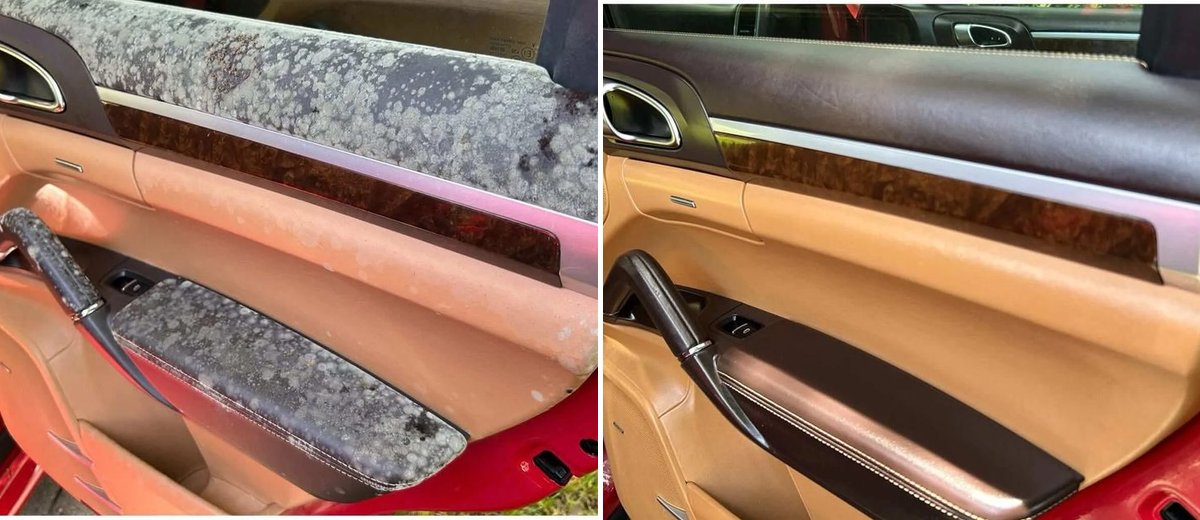
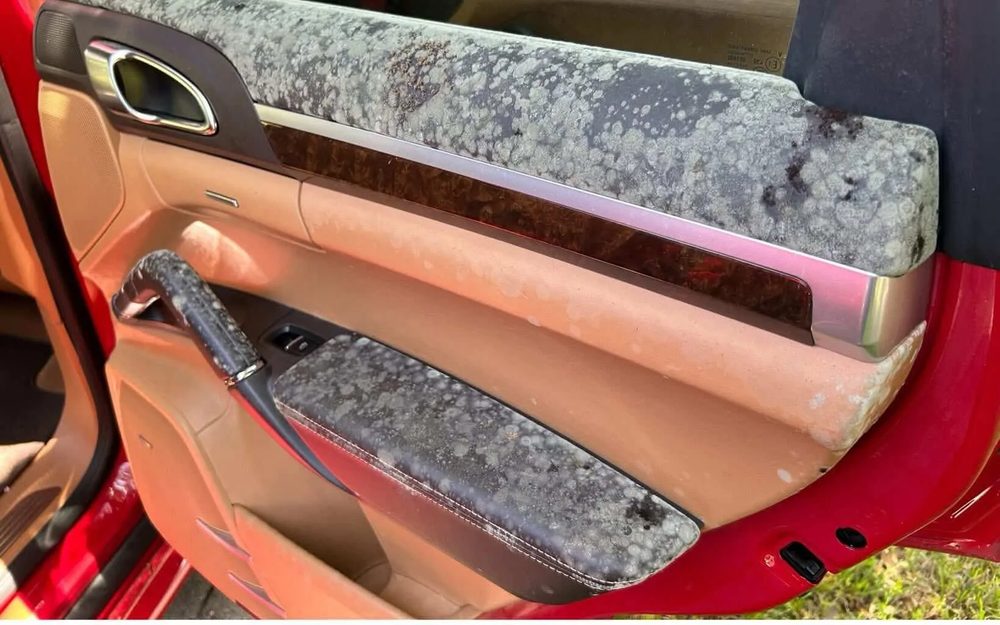 Before
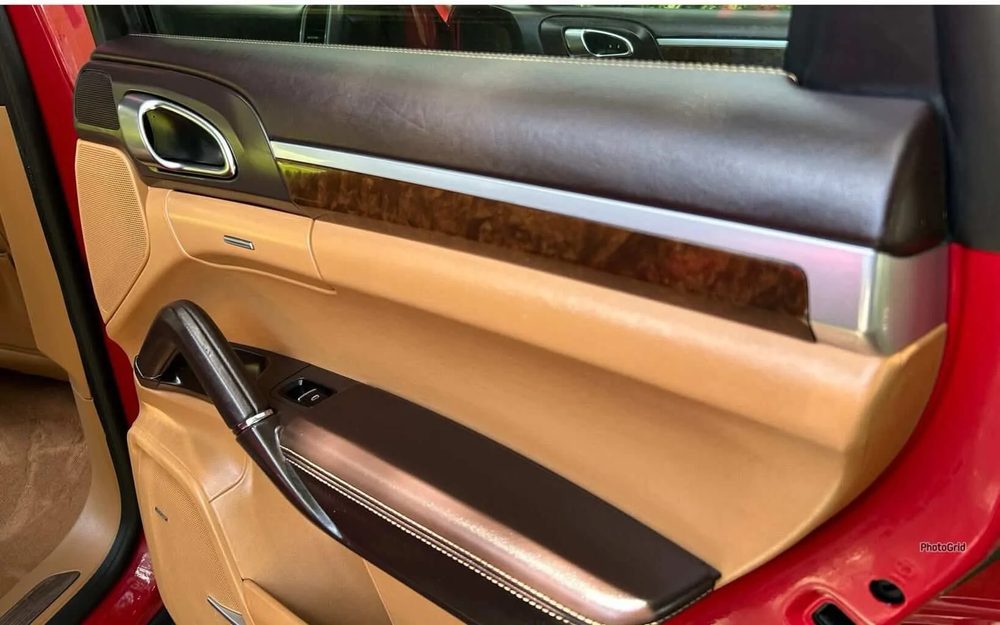 After
Porsche Cayenne — Door Panel & Armrest
Mold spreading across the tan leather door panel and armrest of a red Porsche Cayenne, reaching up onto the wood trim. Leather like this cannot be scrubbed hard, so we use the leather-safe protocol, steam and extraction around the trim, Concrobium and then the sealed ozone cycle. Door panels tend to collect moisture first at the lower seals, and in a city where cars are driven wet and rained on every afternoon, that is where it often starts.
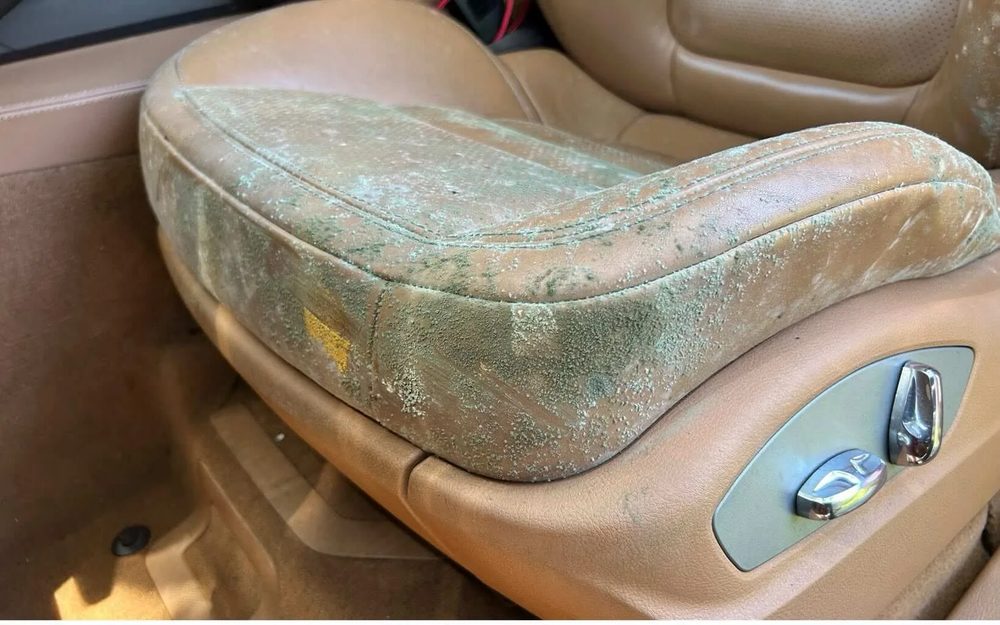 Before
 After
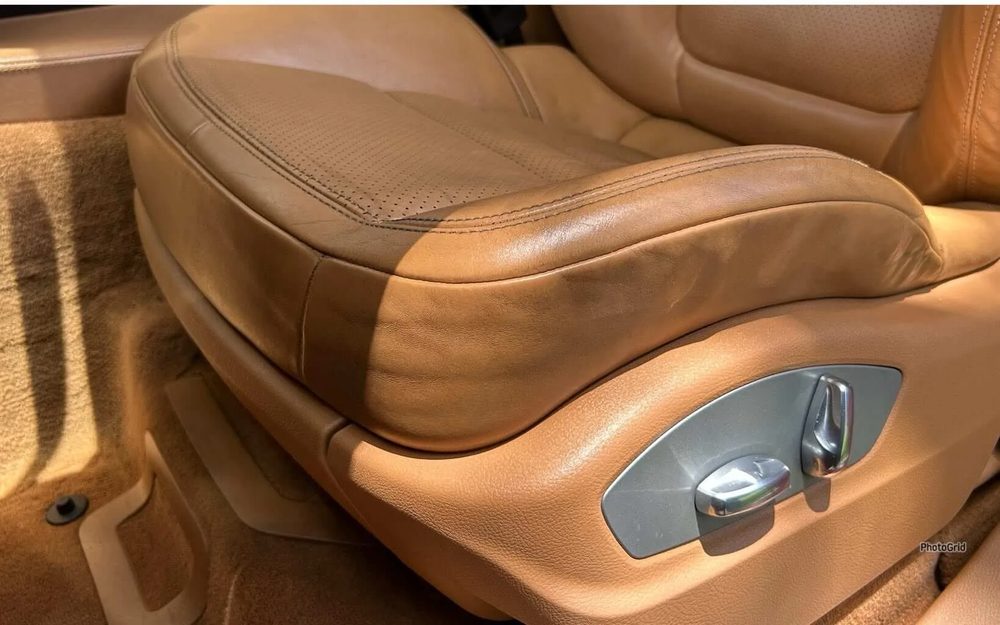
Tan Leather Seat — Bolster Mold
Green-blue mold covering the bolster of a tan or camel leather front seat, the part you rub as you get in and out. On leather the rule is to lift the growth without stripping the finish: a leather-safe antimicrobial, careful extraction and Concrobium, with ozone for the air. This kind of growth is common in daily-use cars where damp clothes and rainwater touch the seat day after day.
 Before
 After
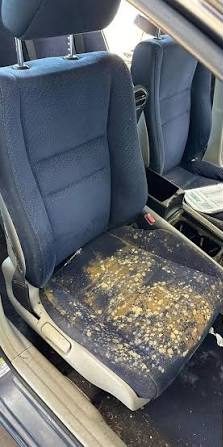
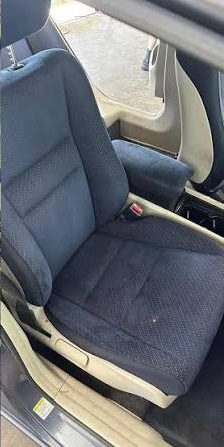
Dark Blue Cloth Seat — Stained Cushion
A dark blue cloth sedan bench seat with the cushion lifted, showing tan and yellow mold-stain residue on the underside. Cloth and foam hold water, so we steam, extract and dry from the inside, then apply Concrobium Mold Control. The stains show where moisture sat for a while, a pattern common where a cabin is shut up damp after rain and rarely gets fully aired out.
 Before
 After
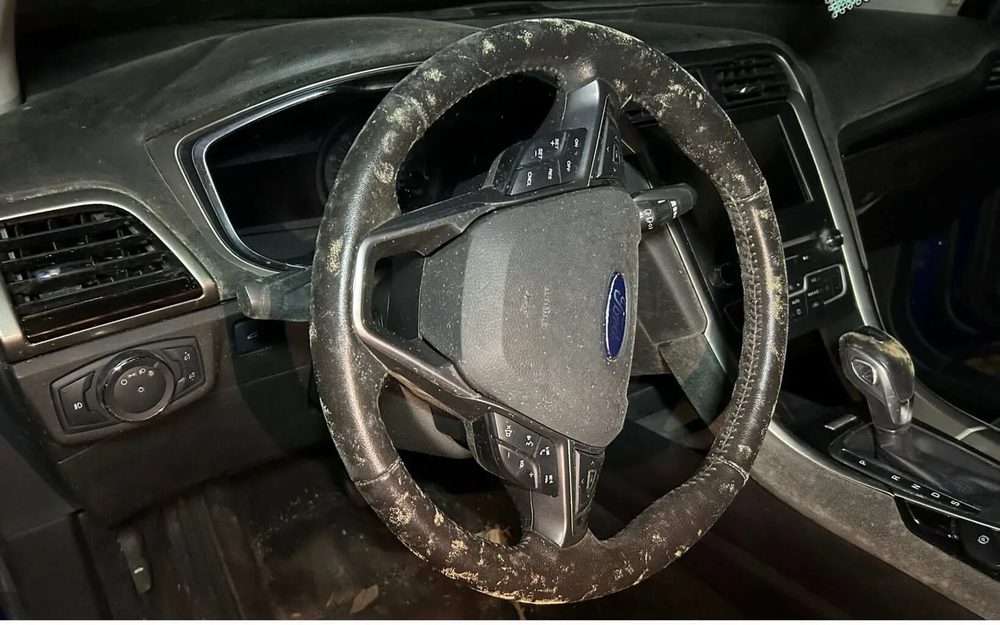
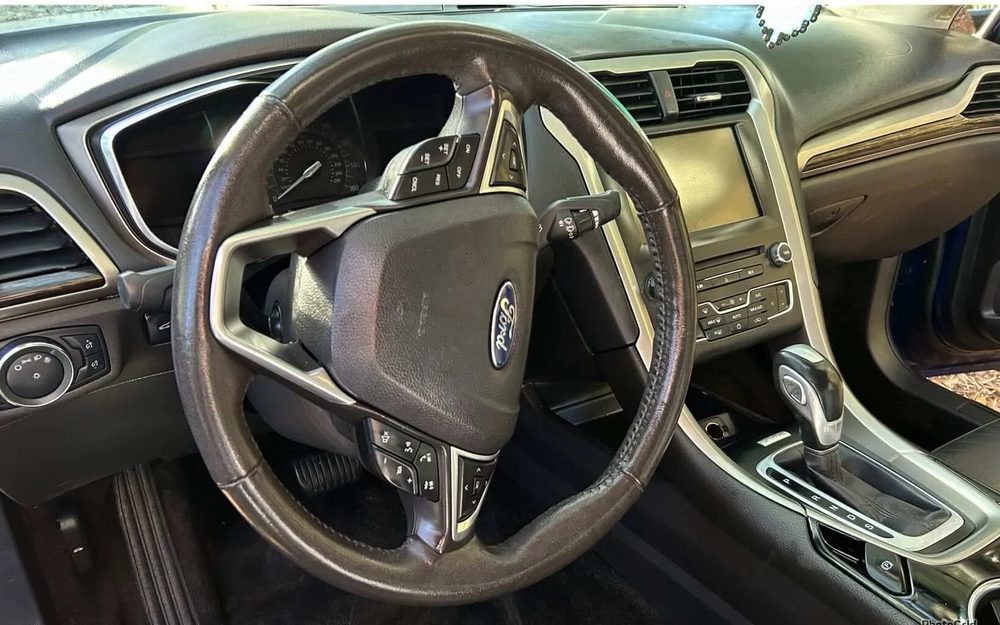
Ford Sedan — Steering Wheel, Dash & Vents
Grey-white mold bloom on the steering wheel, dash and vents of a Ford sedan. The steering wheel is a surface you touch, so the work is a careful clean and a decontamination, followed by the sealed ozone cycle that also reaches the ducts behind the dash. Growth on the vents often points to a damp A/C system, which is common where short trips never let the evaporator dry.
 Before
 After
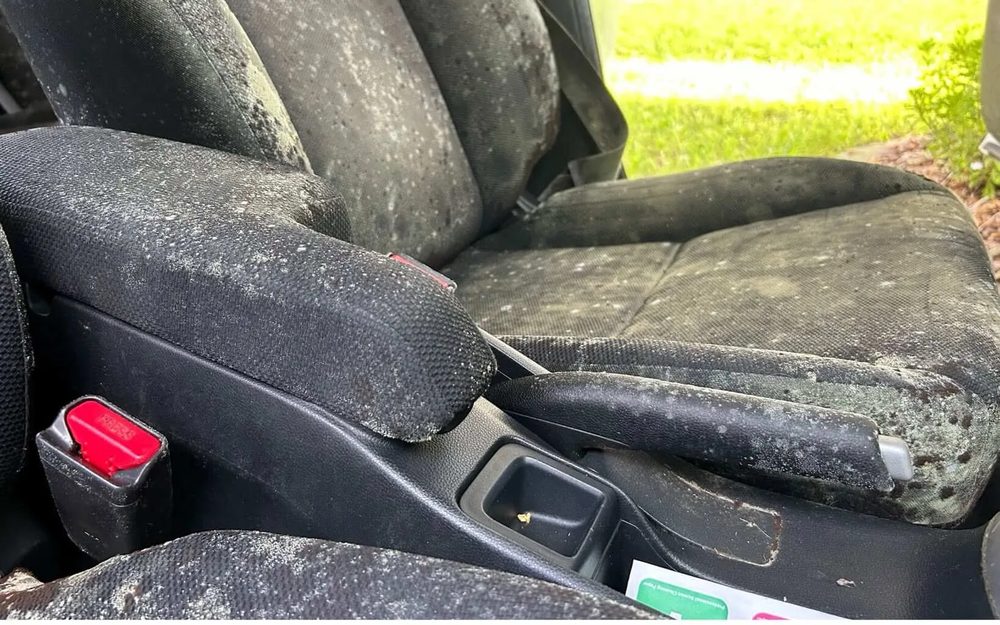
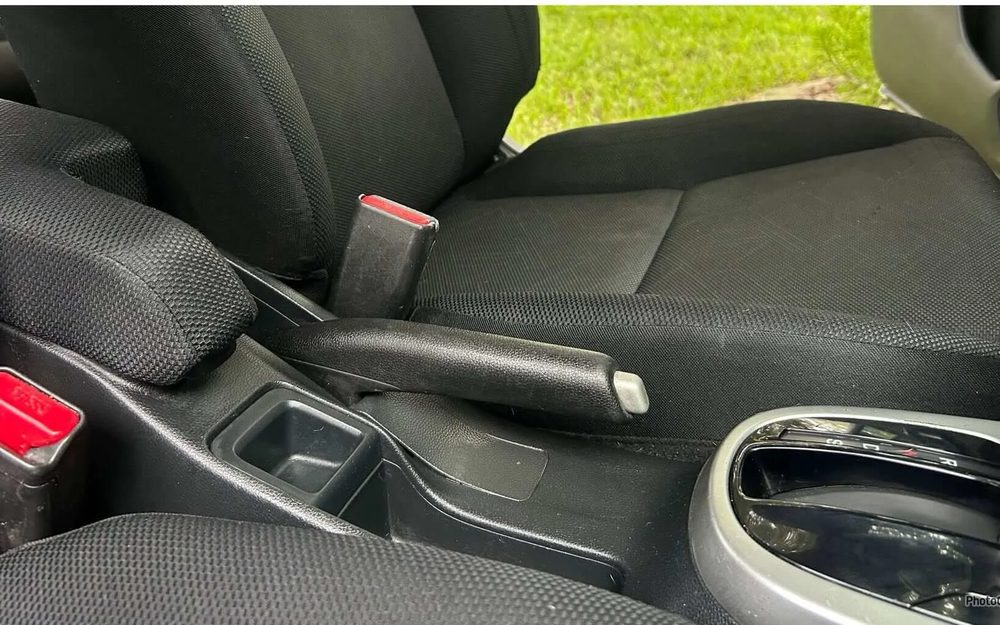
Black Cloth Seat & Console — Mold Bloom
A black cloth driver seat, armrest and console with grey-white mold bloom, with green lawn visible outside the window. Dark fabric hides early growth, so it is often found late. We HEPA-vacuum first so the spores are not blown around, then steam, extract and treat with Concrobium. Cabins that stay closed and humid between drives tend to show this pattern in the rainy season.
 Before
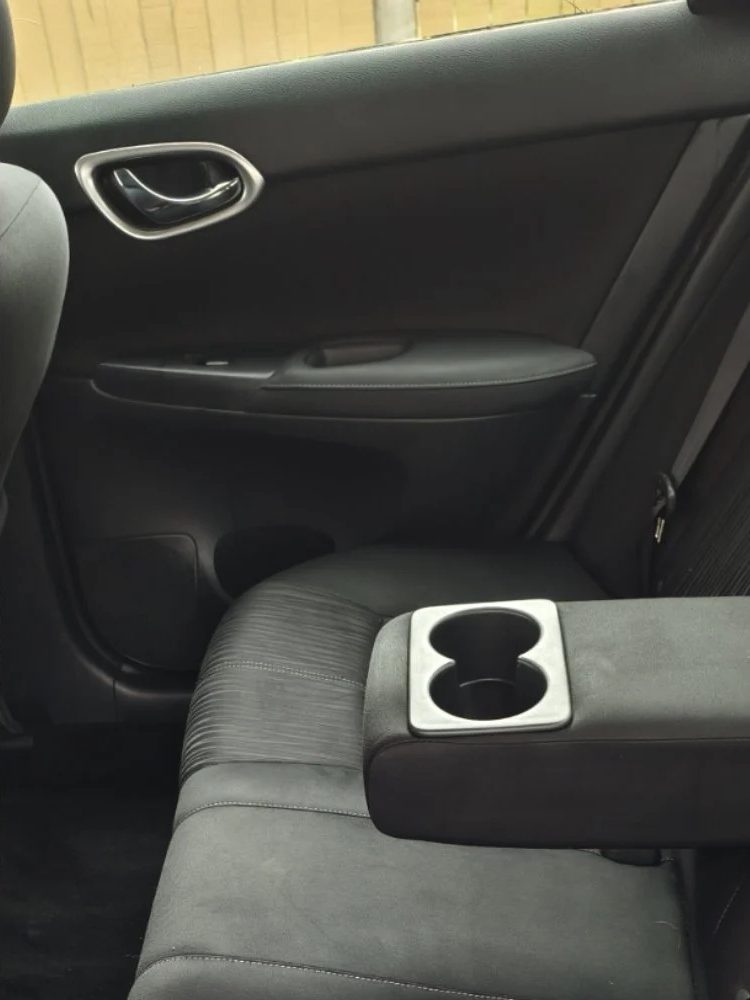 After
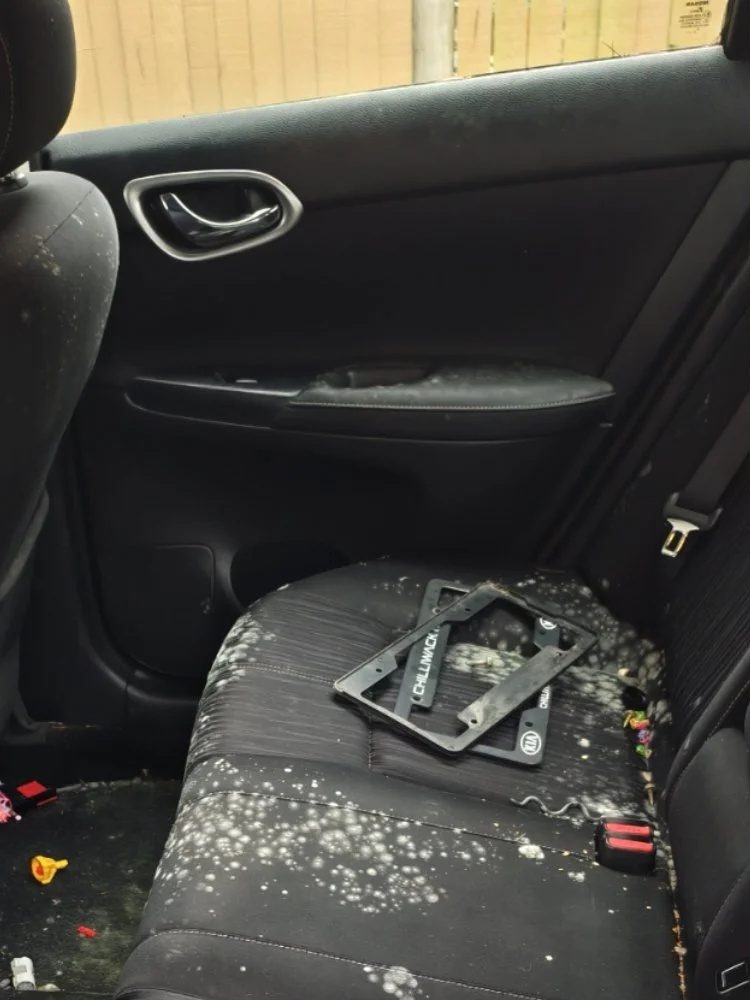
Black Sedan — Rear Seat & Door Panel
White mold spots on the rear cushion and door panel of a black sedan, with loose debris and a license plate frame left on the seat. Rear seats are the first place a wet bag, a child seat or a drink sits unnoticed. We clear it, vacuum, steam and extract, then treat with Concrobium and ozone. In a city of daily-use cars, the back seat is a common place for dampness to hide.
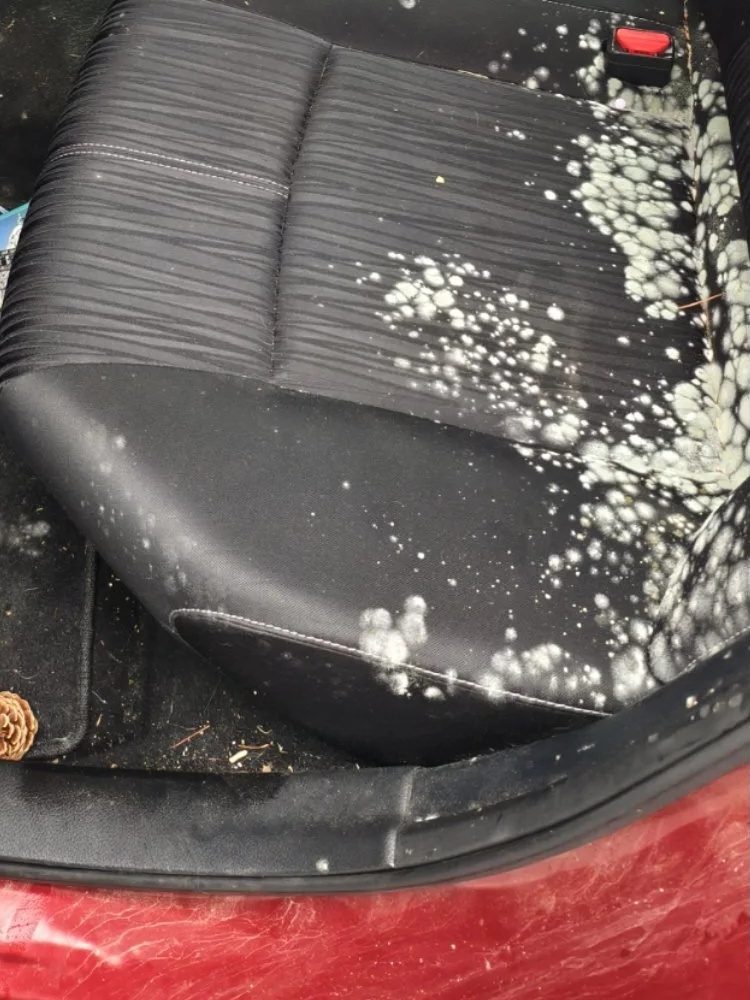 Before
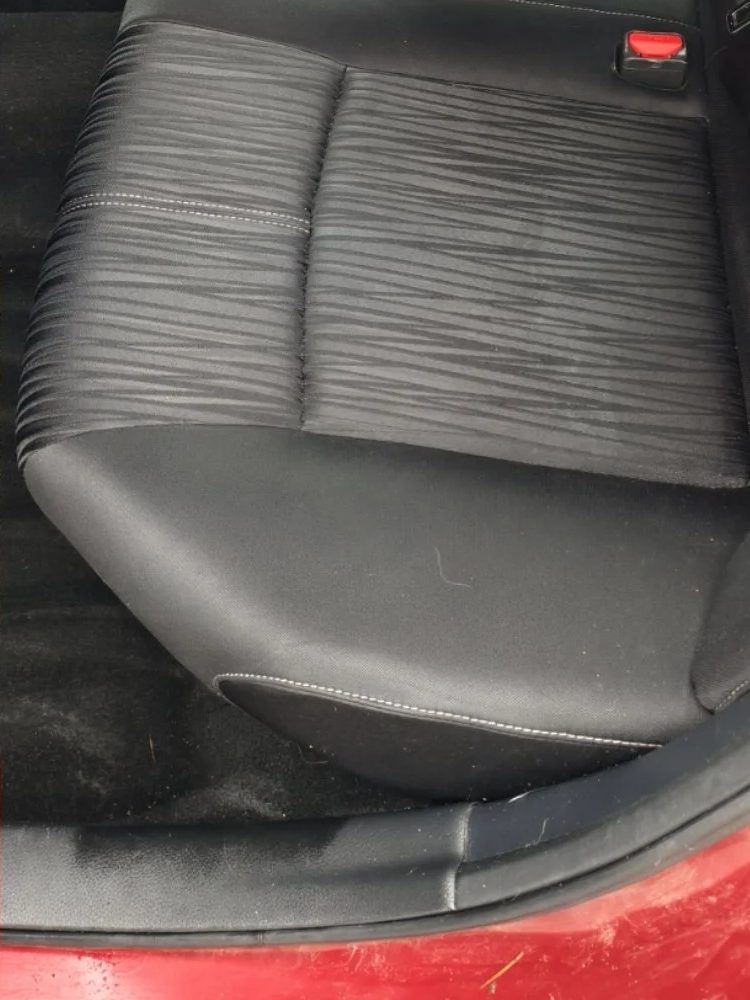 After
Black Cloth Seat — White Speckles
White mold speckles scattered across a black cloth seat, with a red car body visible below the window. Speckling like this is early to middle growth, the stage at which treatment is most likely to stay in the one-area tier. We vacuum, steam, extract, dry and treat with Concrobium. It is a pattern seen where a cabin is shut up humid after rain and stays that way for a while.
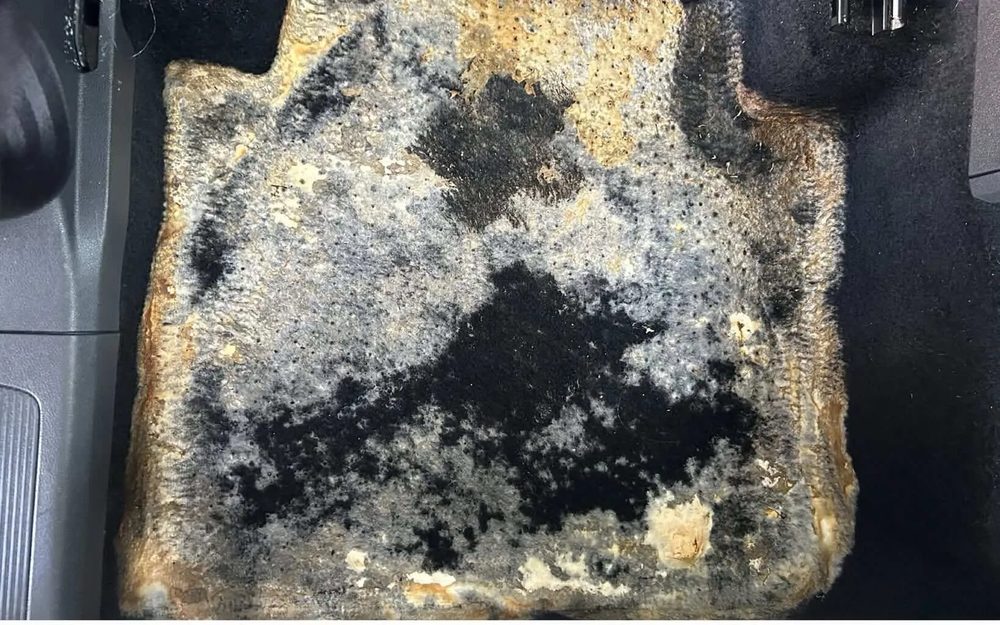 Before
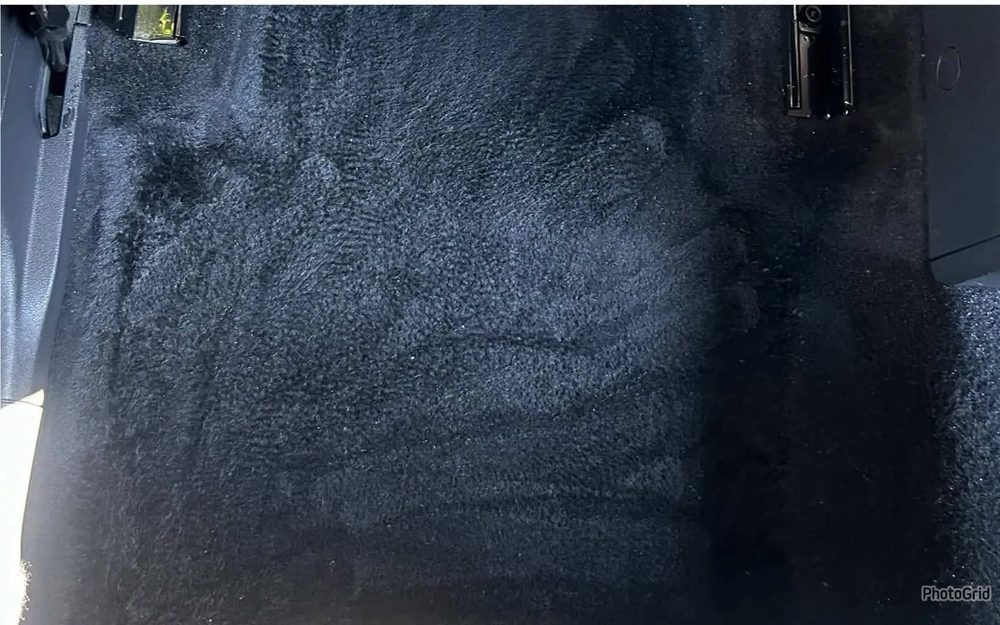 After
Floor Mat — Heavy Colony Growth
A carpeted floor mat with heavy black, brown and white mold colonies. Floor mats take the most moisture because everything wet ends up there, and the carpet and padding below are often affected as well. We lift the mat, vacuum, steam, extract and treat the carpet and foam with Concrobium. For work vehicles that take wet boots, tools and rain, the floor is the first place growth takes hold.
100% Satisfaction.
Written. No exceptions.
If the result doesn’t meet our standard, or yours, we come back and redo it at no charge. No forms to fill out, no arguing over what “counts.” The guarantee is in writing before we ever touch your vehicle.
Request Mold Removal in Hialeah Gardens · From $549
Fill this in once and send it. We get your address, vehicle, and the situation all in one message, no phone tag.
Rating
Detailed
Response
Three steps from a damp work van to a dry cabin,
and we handle everything in between.
No drop-off. No waiting. We come to Hialeah Gardens.
We come to you in Hialeah Gardens,
to the driveway, the shop lot or the yard.
Mobile service: home, office, condo, or marina. No drop-off, no travel fee.
Not seeing your city? Ask us — we likely cover it.
Daily rain, wet gear and short A/C trips
keep a Hialeah Gardens cabin from ever drying.
Hialeah Gardens is a small city where almost every home is occupied, so cars here are driven daily and picking up wet boots, rain and tools, and the cabin rarely gets a full day to dry. Left untreated, what starts as a musty smell becomes a real health issue for the next person who drives the car. DShine's Concrobium Mold Control and ozone process address the cause, not just the symptom, backed by $2M insurance and a written guarantee. Mold doesn't need much to get started, any trapped moisture inside a closed cabin is enough given South Florida's humidity. The source is almost always one of four things: a clogged AC condensation drain letting water pool silently on the floor pan, a failed door or window seal letting rain in, a clogged sunroof drain, or the car simply sitting unused for two or more weeks without the AC running. In Hialeah Gardens the cause we meet most is daily use, not neglect: a work van or pickup closed up wet every night, then loaded again before the carpet and the foam beneath it have dried.
Hialeah Gardens areas we serve,
from NW 87th Avenue to NW 107th Avenue.
From Westland Gardens Park and NW 107th Avenue to Okeechobee Road and city hall, parking and moisture change from one part of Hialeah Gardens to the next.
Westland Gardens Park — Westland Gardens Park, at 13501 NW 107th Avenue, has a heated pool, tennis and basketball courts, a baseball field and a children's wet zone. Families arrive with wet towels and swimsuits, and cars sit shut in the sun afterward. Tell us the address where the car sleeps, because we treat it there, not at the park.
Botanical Garden & NW 107th Avenue — The city's free five-acre botanical garden, with more than 500 species and 45,000 plants, sits at the east end of Westland Gardens Park. Visitors on foot park for an hour or two, so the risk here is one wet event, like rain through a cracked window. We service your home or work address near this corridor.
Brigade 2506 Museum Area — The Assault Brigade 2506 museum, at 13651 NW 107 Avenue, holds a B-26 bomber, an M41 tank and more than 800 photographs. Cars parked around the corridor go through the same afternoon rain as everywhere else. If your address is nearby, send us the street and any gate or lot rule, and we will plan the visit around it.
Okeechobee Road & the Medley Line — US 27, or Okeechobee Road, runs along the Hialeah Gardens border with Medley, a town whose official motto calls it the perfect place for industrial development. Vans and commuter cars park in shop lots and yards here. For these we need a contact name and any check-in rule, plus room to open every door.
Palmetto Expressway & NW 103rd Street — The Palmetto Expressway (SR 826) has interchanges with US 27 and with NW 103rd Street (SR 932) on the Hialeah Gardens line. Residents who commute along it leave cars in a lot for a full shift, then cool the cabin with hard A/C. We meet you on a day off or at a lot with an access contact.
Golden Eagle Park — Golden Eagle Park sits next to Hialeah Gardens Elementary and has a playground, bathrooms, a concession stand and gazebos. Cars in the surrounding blocks are family vehicles with school bags, snacks, drinks and the occasional wet jacket. Spills and a child seat left damp after a storm are the usual causes we look for.
City Hall & NW 87th Avenue — Hialeah Gardens city hall is at 10001 NW 87th Avenue, in ZIP 33016, and the streets around it hold homes, offices and service lots. Cars here use driveways, curbs and small lots, and some are work trucks that go home with their drivers. We confirm room to open every door and the best arrival window.
Don't see your area? Ask us — we likely cover it.
Hialeah Gardens car mold,
what drivers of work trucks and family cars ask first.
Tap any topic to read the full breakdown.
Hialeah Gardens sits about 7 feet above sea level in northwest Miami-Dade County, on 3.67 square miles of which 3.22 are land and 0.45 are water. Hialeah borders it to the north and east, Medley to the southwest, and US 27, better known as Okeechobee Road, runs along the Medley line. The city is compact, so almost everything is a short drive from everything else.
Our rainfall figures come from the closest long-record station, Miami International Airport, and not from a gauge inside the city. Over 1991 to 2020 it averaged 67.41 inches of rain a year on about 141 measurable-rain days, with relative humidity near 73.2 percent. The heaviest months are June (10.51 inches) and September (10.22), and the rainy season officially stretches from about May 15 to October 15.
What sets the city apart is how little of it sits empty. The 2020 Census counted 7,395 housing units here with only 1.9 percent vacant, and Census QuickFacts puts the average household at about three people. Cars here are driven every day, so the moisture usually rides in with the owner, as wet boots, rain on the mat and a hot cabin shut tight overnight, not from months of neglect.
The city began as a tourist camp, the Walter C. Ohlerts Tourist Camp, and voters incorporated it on December 1, 1948. It stayed a rural community, known for horse raising, until 1968, when it adopted a land use and zoning master plan. Population has grown from 121 residents in 1950 to 23,068 in the 2020 Census.
The pattern that stands out is the one-vehicle business: a pickup or cargo van that carries the tools and ladders by day and the family on Sunday. Nobody washes the cargo floor between those two jobs. Wet mats get thrown back in, a damp rag stays under the seat, and the cabin that was hosed down at four o'clock is closed up for the night still holding water.
Next come the older second cars, the sedans and compact SUVs that have a lot of miles and a tired A/C. Their door seals and condensate drains have usually been working harder than they were designed to for years, so a small leak that nobody has time to chase becomes a damp patch under the carpet and then a smell.
Third, the commuter cars. Medley, next door, calls itself the perfect place for industrial development, and its warehouses and plants sit a short drive from most addresses in Hialeah Gardens. Cars that spend a work shift in a sun-baked lot, then run cold A/C on the drive home and are shut up damp again, present a different problem from a work van but end in the same musty cabin.
Families with children are the other regular. A weekend at the pool or ball field in Westland Gardens Park means wet swimsuits, towels and cleats dropped on the back seat, then a closed car in the sun. The mold shows up there as dark speckles along the seat seams and a sour smell that comes back after every rain.
Driveway or carport at the house, with or without a garage: the most common setup, and it takes the weather head-on. A carport roof stops the worst of the rain but not the wind-blown kind, and a car nose-in on a driveway also collects sprinkler overspray. Where the garage doubles as a workshop, tools and boxes block the air around the car, and an uncooled space tracks the humidity outdoors.
Street or swale parking: cars left at the curb sit in the splash of every passing vehicle, and after a heavy downpour the water that gathers along a kerb can reach the door sills. Then there are the leaves and grit that settle in the cowl under the windshield, where the drain channels run, and a clogged cowl sends water to the footwell with no leak you can see from outside.
Apartment or townhome lots: shared lots rarely have cover, and a car may go a week or more between drives while its owner works shifts. When it does move, it is a short run to the shop and back, which gives the A/C no time to dry the evaporator. That combination of open-air rain and short trips is a quiet recipe for a musty smell that returns every few weeks.
Employer lots and shop yards near Okeechobee Road and Medley: cars here bake through the workday and are then cooled hard on the drive home. For vans and trucks the added risk is cargo: a bucket that leaked, a wet tarp or a cooler left on the floor can keep a bare floor damp behind the seats for days, out of view and out of mind.
Mid-May to mid-October, the rainy season: this is when most of our Hialeah Gardens calls begin. Rain falls on most afternoons, the airport records its heaviest months in June and September, and a work truck that is loaded, unloaded and rained on again never gets a day to dry. The carpet is damp at dawn, and the mold needs only 24 to 48 hours to start.
June 1 to November 30, hurricane season: storm prep pulls vans and cars into odd places, windows get shut tight for days and tools are brought inside. After the storm, the exposure is a car that sat closed up with damp air, wet leaves in the cowl and sometimes a window that was not quite sealed. A quick check of the footwell the day after is time well spent.
Late fall into spring, the drier months: relative humidity at the airport still averages 73.2 percent across the year, so dry is relative. The common winter pattern is a cooler car with the A/C off and windows closed, a damp mat from a wet morning and cold nights that keep condensation on the glass. The smell tends to come back each time the heater or fan starts.
Any slow week: a truck parked after a wet last shift, or a second car idle while a family member travels, is the case that turns a small spot into a large one. The calendar matters less here than the last thing that happened to the cabin before it was shut up. If it was wet, it does not matter which month it is.
We come to your address, so the first question is where the vehicle actually sleeps. That might be a driveway on a residential street, the lot behind a shop or the corner of a yard near Okeechobee Road, which runs along the line with Medley. We need room to open every door fully, so tell us if the space is tight or shared, and we will plan where to park the van.
Work vehicles add a scheduling piece: the visit takes three to four hours, and a van that is out earning that day is a van that is not available. Most owners choose an evening, a day off or a slow stretch between jobs. If the vehicle is parked at an employer's site, send the manager's name and any gate or check-in rule, and we will fit around it.
Please pull loose tools, boxes and personal items out of the cab and cargo area beforehand, or tell us if something is bolted in and cannot move. The HEPA vacuum and steam need to reach the bare floor, and a ladder rack, a locked toolbox or shelving that stays put is fine as long as we know about it.
Nobody has to stay with the vehicle. Give us the location, a contact number and a window when someone can unlock it, and the before and after photos come to your WhatsApp. The only rule is the one for the ozone step: nobody sits in the vehicle during that cycle, and we confirm when it is safe to use again.
1. Wet gear and cargo shut in overnight: boots, rags, a damp tarp, a leaking bucket or a cooler's meltwater can soak the floor and the foam under it. The fabric looks dry on top in the morning, yet the foam below stays wet for days. Nothing is broken on the vehicle, it is simply used hard and closed up wet, which in this city is the cause we meet most.
2. An A/C evaporator that never dries out: short hops with the A/C on, then the engine off while the coil is still wet, leave moisture sitting in the dark behind the dash. The first sign is a sour or dirty-sock smell when the fan starts. If the condensate drain is partly blocked, the water has nowhere to go and the carpet behind the passenger's feet can start to get damp.
3. Door, window and cowl seals worn by sun: the weatherstripping on a vehicle that bakes outdoors every day cracks and shrinks. Rain gets in at the sill or the base of a pillar in small amounts that nobody sees until a mat feels cold. Leaves and grit in the cowl add to it by pushing water the wrong way.
4. Roof drains and one-off spills: the small drain tubes at the corners of a sunroof can clog, and water then backs up into the headliner and pillars, a hidden leak that shows up as a smell before a stain. A window left open before a storm or a drink on the floor is a one-off that often stays in a single area, so it usually falls in the $549 tier, but left a few days it spreads into the foam.
You send photos, we answer with a tier, and a time is set around the vehicle's real schedule, whether that is a Saturday morning or the hour after a crew gets home. On the day we pull in close enough to open every door, greet whoever has the keys and ask three things: where the vehicle has been, when the smell began and what got wet.
Then the sequence runs from the first look to the final check: HEPA vacuum, Benefect, deep clean, steam, extraction, drying, Concrobium, ozone and the odor bomb. Most visits take three to four hours, shorter when one seat is the problem and longer when growth has crept into the vents, the headliner or under a van's rubber flooring.
The last thing you get is a set of before and after photos on WhatsApp and a plain note on the likely cause, so the next repair goes where the water enters. If you can, leave the vehicle as it is when we come, with no sprays and no scrubbing, because an untouched cabin shows us where the moisture traveled.
Most callers open with the price, and the answer is two numbers: $549 when mold is in one area and $749 when it is through the vehicle, travel included. A few photos get you the tier in under 2 minutes, and the exact figure is locked in after we review them, before any work starts.
Next comes the work-vehicle question: will it handle a bare cargo floor, rubber mats and a cab full of tools? It will. The same 11 steps cover cab and cargo, and we change the extraction for rubber or vinyl floors, where the surface looks clean while water hides at the seams and beneath the seat rails.
People also ask how long they will be without the vehicle. Plan on three to four hours at your address. You do not need to wait with it, and during the ozone cycle nobody sits inside, so the keys and a contact number are all we need from you.
Then comes the question underneath all the others: will the smell stay gone? That is what the written 30-day guarantee answers, free re-treatment if mold or its odor returns in that time, and what we ask in return is that wet gear does not go straight back onto a freshly treated floor.
At the inspection we first sort out whether a vehicle needs mold treatment at all. A stale cabin with no growth suits the $349 Odor Removal service, and one that just took on water, perhaps from a window left down under a Hialeah Gardens downpour, may need only the $349 Flooded Car service if we reach it within days. The lighter service wins whenever it will do.
Owners of work trucks sometimes add Engine Bay Cleaning after long days on dusty sites, and some pair the mold job with a full interior detail once the cab has aired out. Ceramic coating or paint correction can be added too, for paint that has spent years under the sun and the afternoon rain.
Extras are always agreed with you in advance and priced before they start, and the mold job stays first on the schedule. The practical gain is one arrival at your address instead of two, with one set of access arrangements to organize and one afternoon to set aside.
The windshield is often the first witness. If a film of fog or a greasy haze keeps forming on the inside after you wipe it clean, the cabin air is carrying more moisture than it should. A sour burst when the fan first starts, fading after a minute, is another early tell.
Then use your hand. Press the driver's mat, the carpet under the rear seat and, in a truck or van, the cargo floor behind the seats. Cool, clammy fabric on a dry afternoon means water below the surface. Grey dust on a seat seam, or a rust-colored ring where a toolbox sits, is worth a closer look.
Last, listen to your body: a headache, sneezing or itchy eyes that begin when you get in and ease when you get out. If any of this sounds familiar, photograph it in daylight and air the cabin with the doors open. Skip the air freshener, which only hides the evidence, and call early, because a spot caught early often stays in the one-area tier.
Hialeah Gardens vehicles are rarely parked for months, but the idle spells are real: a truck waiting for the next contract, a second car while its driver is out of town, a van left through a long weekend after a wet job. A few closed days are all a damp cabin needs, so what matters is the state the vehicle is in when it stops.
On the last drive, bring the cabin back to dry. Take out boots, rags, towels and coolers, stand the mats up in open air, and let the fan run on its own for a few minutes before the engine goes off, so the A/C coil loses its water. Close the windows and the sunroof completely, and look at the door seals while you are there.
If it will sit more than a week, ask someone to open the doors on a dry day and run the fan for a few minutes. That small exchange of air breaks up the stagnant pocket mold needs, and it works as well in a Hialeah Gardens driveway as anywhere else. If you come back to a sour smell, send us a photo before you carry passengers, since early cases are smaller ones.
Households here average close to three people, so a driveway often holds a work truck, a commuter sedan and perhaps a car that a teenager or a grandparent drives. They share a curb, the same afternoon storms and, more important, the same wet gear moving from seat to seat. When one vehicle is musty, check its neighbors.
Bring them all to one visit. We inspect each vehicle on its own merits and price each one separately, so a damp cargo van might be $749 while the sedan beside it is clean and costs nothing. Those figures are agreed before we start, and nobody pays to treat what does not need it.
For a small business, send the plates and where each vehicle sleeps, and we line up the order of work around the space available. Every vehicle gets its own photo set and its own 30-day guarantee, which keeps the records easy to file.
Think of the guarantee as a promise about the next 30 days. We put it on paper, and it says that if mold or its odor shows up again in that window we come back and do the treatment over, at no charge. You only need to send a note and a few photos.
A treated vehicle can still grow mold if water keeps entering: a perished seal, a blocked sunroof drain, an A/C line that drips into the footwell. That is why our visit ends with an honest note on where we think the water came from. Fixing that cause is the best way to make the guarantee a formality.
On a hard-working vehicle, the habit that matters most is simple: wet things come out when the work is done. Boots, tarps and coolers that go straight back onto a newly dried floor restart the problem. Tell us how the vehicle is used, and we will name what to keep an eye on.
A truck or van with many miles of daily work is a different patient from a garage-kept sedan. Its seat foam has been soaked and dried many times, its door rubber has hardened, and a rubber or vinyl floor can look spotless while moisture lingers along the seams. We plan longer drying on these and go gently near brittle trim.
One more thing we do differently on a high-mileage work vehicle is ask what usually rides in it. Rags, hoses, tarps and tools tell us where the damp tends to collect, and so where we look first, before the first product is opened.
When there is leather, the leather-safe protocol applies: a mild antimicrobial, no heavy scrubbing, and the ozone cycle for the air. A seat that is already stained or cracking will be described honestly at the inspection, since our work halts growth but cannot restore a finish that has already failed.
Last, we name the inexpensive repairs that stop a repeat visit: a split drain tube, a worn door seal or a sunroof gasket. Fixing one of those costs a fraction of a second treatment, and it is better to hear about it on the day than a month later.
Before the engine goes off: clear out anything that held water, such as towels, boots, ice chests and rags, and in a van, lift the cargo mat to be sure the floor beneath it is dry. That one step removes most of what mold feeds on, and it takes a couple of minutes.
While you park: switch the A/C compressor off a few minutes ahead and let only the fan run, so the coil dries. Choose dry ground when you can, and open a door for a minute to swap the air. Run a finger along the seals, then confirm each window and the sunroof is fully shut.
On the way out: peek into the footwells, the cowl at the base of the windshield and the cargo corners for puddles, leaves or grit. Before a storm or a trip, these two minutes cost nothing, and they are far cheaper than a mold job after a week of damp.
A damp mat found early is a one-area job at $549. Leave the same mat through a few weeks of rainy-season afternoons and the foam under it holds water, the vents start to smell and the job moves to the $749 tier, because by then the work covers the vehicle. Mold needs only 24 to 48 hours to begin, and the rest is time.
On a work vehicle there is a second price: a cab that a driver would rather not sit in, or a smell a customer notices when stepping up. A van also runs on fixed hours, so a cabin that keeps getting worse is one that gets harder to fit into the schedule.
The cabin air is recirculated, so spores and odor reach everyone inside quickly, and people with allergies or asthma notice first. None of this calls for panic over one damp spot, but it does argue against waiting out the summer before calling.
Census figures put the mean commute for Hialeah Gardens residents at 30.5 minutes. Many cars then sit through a shift in a lot at a shop, a warehouse or an office, so the cabin heats in the Florida sun to the point where any dampness in the carpet turns to steam.
On the drive home the A/C blasts cold air at that hot, wet cabin, and condensation forms on the coil, the vents and the glass. When the car is turned off and shut up again, the moisture stays. Over weeks that cycle leaves a musty smell that is stronger in the morning and weaker once the fan has been running.
If your car lives on the Okeechobee Road side of town or at a job in Medley, send us the address of the lot or shop and the shift window. We can usually meet you on a day off, or arrange an access contact if the vehicle is parked at an employer's site.
Time of day matters too. A night-shift worker's car sits in the heat of the afternoon with the windows up, while the day-shift car is parked at dawn when the air is thick with dew. Both leave the doors sealed over a damp mat, so we ask which shift the car follows when we plan the visit and the arrival window.
Nothing gets sprayed before a number is agreed. You send photos and a sentence about where the vehicle lives, and within 2 minutes we name a tier: $549 if the mold stays in one area, $749 if it runs through the vehicle. Our drive to Hialeah Gardens is already inside that figure.
We then look through everything you sent and confirm the exact price before any work starts. Should something turn up that the photos did not show, we call it out first, and any change waits for your yes. The amount on the invoice is the amount you approved.
Good photos shorten all of it: the worst spot, the floor or cargo area and a wide shot of the seats. For a work vehicle, tell us what usually rides inside, whether that is tools, tarps, a cooler or a child seat, because it points straight to the likely cause.
In brief: Hialeah Gardens packs about 23,000 people into 3.22 square miles of land, with almost no empty homes, so the mold we find here grows out of daily use rather than idle properties. Wet gear in a truck, short A/C hops, sun-worn seals and storms from mid-May to mid-October are the usual story.
The price is $549 when the mold is in one area and $749 when it is throughout, with the drive to your driveway, shop lot or yard included and the exact figure confirmed from your photos before work starts. Nothing is added afterward, and nobody has to be home.
Expect three to four hours, eleven steps and a written 30-day guarantee that covers a free re-treatment if mold or its smell returns. We are IDA certified and insured for $2M, and before and after photos of the finished job reach you on WhatsApp when the work is done.
Ozone is the last treatment, applied after the hands-on work, and it has a single job: to go where we cannot. With the vehicle closed and empty, a generator fills the cabin and works its way into the foam, the headliner and the ductwork behind the dash, breaking down odor and any spores still floating in the air.
Safety comes first. Nobody stays in the vehicle while it runs, and we ask that people and pets keep away from the doors until the timer ends. Then we open it up wide and let it air out before the Meguiar's odor bomb and the last inspection, and we say when you can sit in it again, not before.
Setup is simple in Hialeah Gardens: a driveway, the open door of a shop or a corner of a yard gives enough air movement, and we choose the spot with you. A truck with thick seat foam can hold a faint smell longer, so we may keep ventilating, and we tell you what to expect over the next day.
Before you book,
answers for Hialeah Gardens drivers.
Add-ons Hialeah Gardens clients book
Still deciding? Read: the complete mold removal guide · does insurance cover it? · why DIY mold removal fails.
Mold in your Hialeah Gardens car or truck? Get your price in 2 minutes.
Serving Hialeah Gardens and all of Miami-Dade County. Fixed pricing, no travel fee. We confirm in under 2 minutes.
It Might Just Be an Odor Problem
If there's no visible mold growth yet, the smell alone is usually an Odor Removal Detailing case ($349 flat) — faster than full mold remediation ($549–$749). See which one matches what you're dealing with: