What a Coral Gables Mold Job Includes
This is not a car wash. Car Mold Removal uses Concrobium Mold Control treatment, pH-balanced products, and machine assistance, the same process used in pre-sale preparations for luxury dealerships.
Why it matters for your health: Mold in a vehicle is a different exposure than mold on a wall at home. With the AC recirculating, everyone inside is breathing concentrated spores for the length of the drive. The EPA and CDC both link mold exposure to respiratory irritation, allergic reactions, headaches, and worsened asthma symptoms. Children, older passengers, and anyone with a compromised immune system typically react faster and more severely than a healthy adult would. By the time the smell is noticeable, spores have usually already spread through the HVAC system into every vent in the cabin.
Curious what actually happens during the visit? Tap through our real 11-step process below to see what we do at each stage and why it matters.
What every Coral Gables mold job gets you
Most detailers in Coral Gables charge less. Here’s exactly what you gain — and what you risk — with each choice.
| DShine DetailsFrom $549 · travel included | Avg Coral Gables Detailer$149 – $199 | |
|---|---|---|
| Industry certificationsIDA, Koch Chemie, Meguiar’s, 3M, Symplex, XPEL | ✓6 verified | —0 credentials |
| $2M liability insuranceWe cover any damage — in writing | ✓ | —Often uninsured |
| Deionized water systemZero mineral residue, no water spots | ✓ | —Tap water, water spots |
| Fresh microfibers per vehicleNo cross-contamination between jobs | ✓ | —Shared towels, swirl risk |
| Mold-specific chemistry onlyConcrobium, Benefect & Meguiar’s, no harsh acids | ✓ | —Industrial degreasers |
| Before & after photosSent via WhatsApp on completion | ✓ | —No documentation |
| 100% written satisfaction guaranteeReturn & redo at no cost if unsatisfied | ✓ | —No written guarantee |
| Travel to your address — $0Home, office, condo — no drop-off | ✓ | Sometimes adds fee |
DShine vs. any other detailer
in Coral Gables, Miami-Dade County
Three things most detailers won't tell you. We put them in writing.
 Since 2018
With more than 20 years of hands-on experience in the automotive care industry, Evelio launched DShine Details in August 2018 with one van and zero shortcuts. For the first six months he slept in the van to keep costs down and standards up. Today DShine runs 7 certified vans across Miami-Dade, Broward, and Palm Beach, and the commitment hasn't changed. Every vehicle is treated as if it were his own.
What clients say
in their own words.
Before & After: Mold Removal We've Actually Done
No stock photos. These are real DShine mold removal jobs across South Florida, the same 11-step process and chemistry used on every Coral Gables appointment.
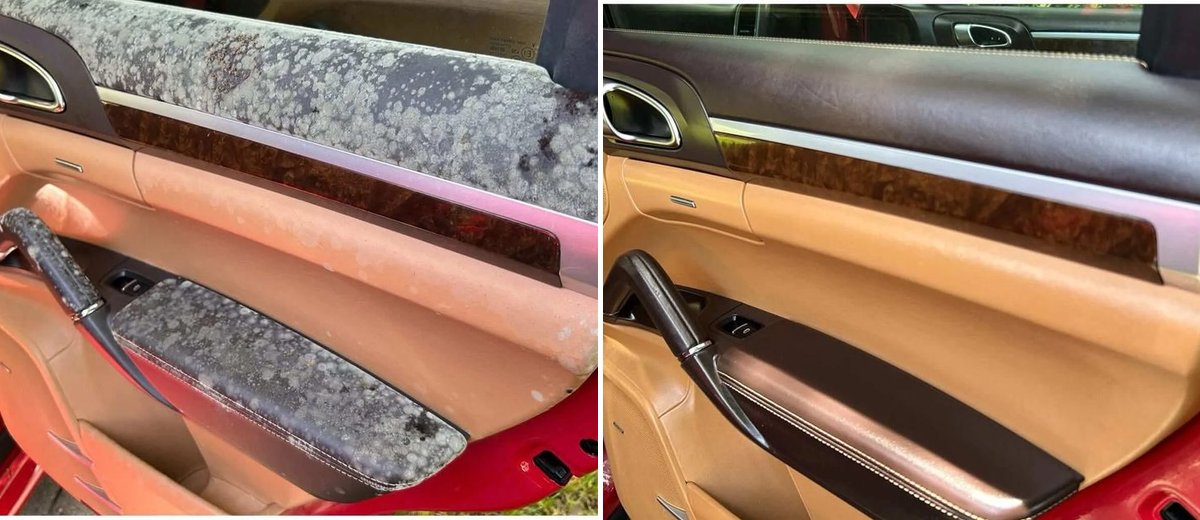
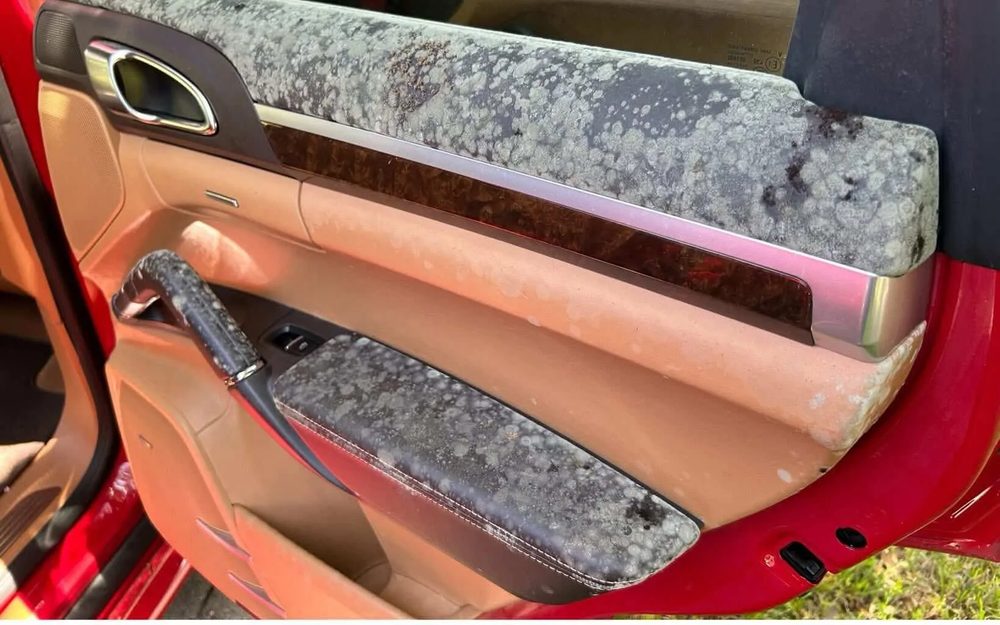 Before
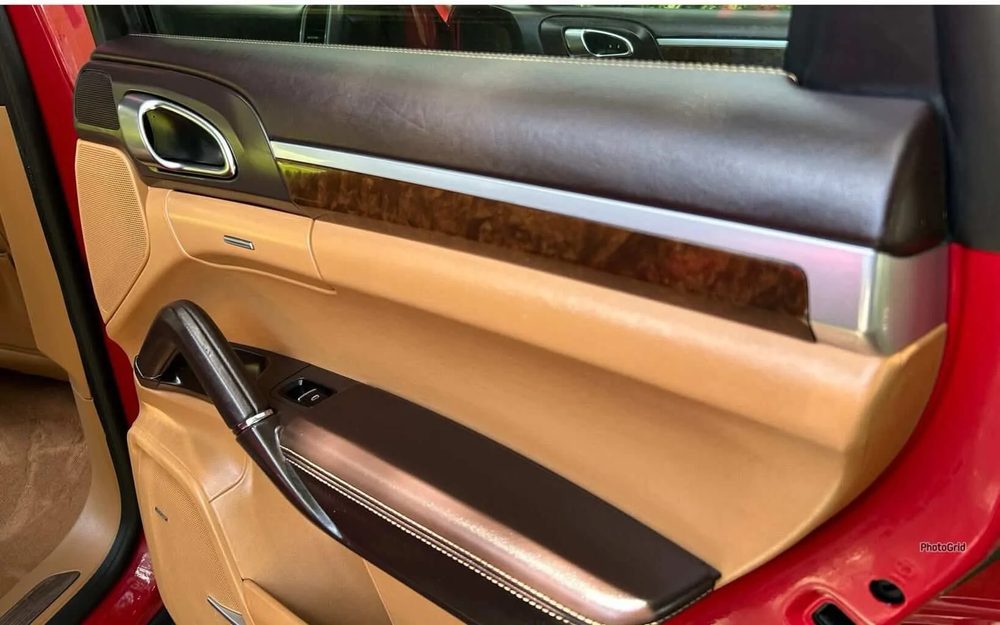 After
Porsche Cayenne — Leather Door Panel & Armrest
Mold spread across the tan leather door panel, armrest and wood trim of a red Porsche Cayenne. Leather like this cannot be scrubbed hard, so we use the leather-safe protocol, steam and extraction around the trim, Concrobium and then the sealed ozone cycle. Door panels collect moisture first at the seals, and in a shaded Coral Gables driveway those seals stay damp long after a shower.
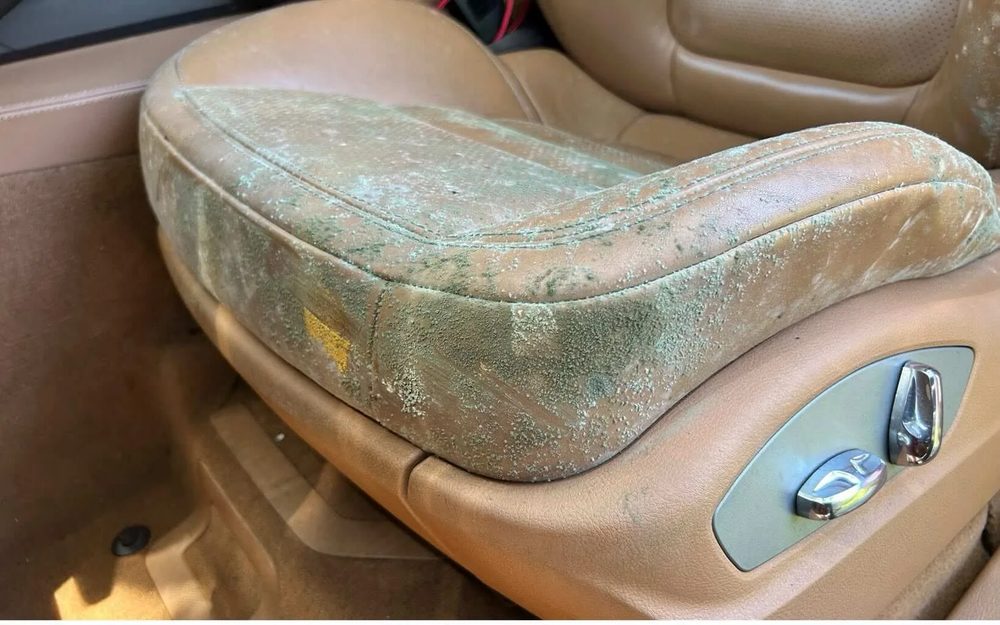 Before
 After
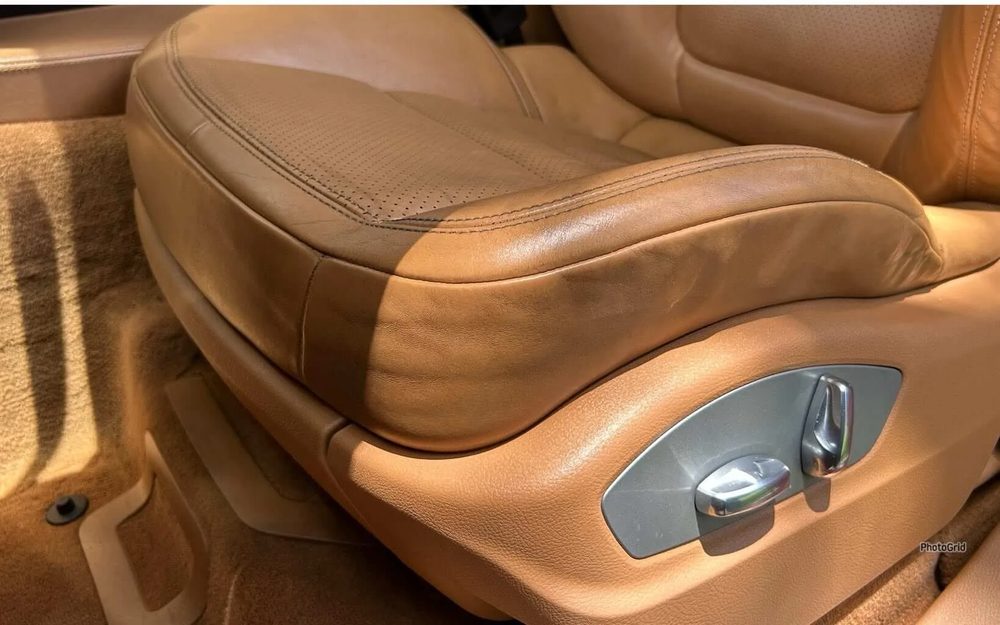
Tan Leather Seat Bolster — Green-Blue Growth
A camel-colored leather front seat bolster covered in green-blue mold. The bolster is the part of the seat that rubs the door and traps moisture, and leather will not tolerate harsh scrubbing, so it gets controlled steam, careful extraction and Concrobium before the ozone cycle. Cars kept under heavy tree cover in Coral Gables can sit damp long enough for this kind of growth to take hold on seats.
 Before
 After
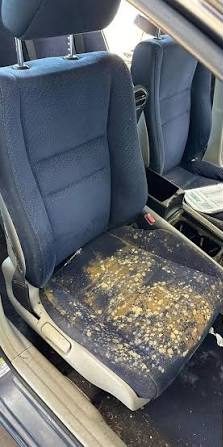
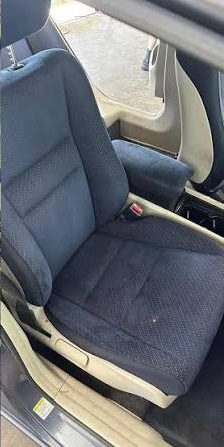
Cloth Bench Seat — Mold Stain Residue
A dark blue cloth sedan bench seat with the cushion lifted, showing tan and yellow mold-stain residue on the underside of the seat bottom. Staining like this means moisture has soaked into the foam, so we pull it out with steam and extraction, treat with Concrobium and finish with ozone. Slow-drying shade and a leaking cowl or sunroof drain are the kind of conditions that produce this pattern in Coral Gables.
 Before
 After
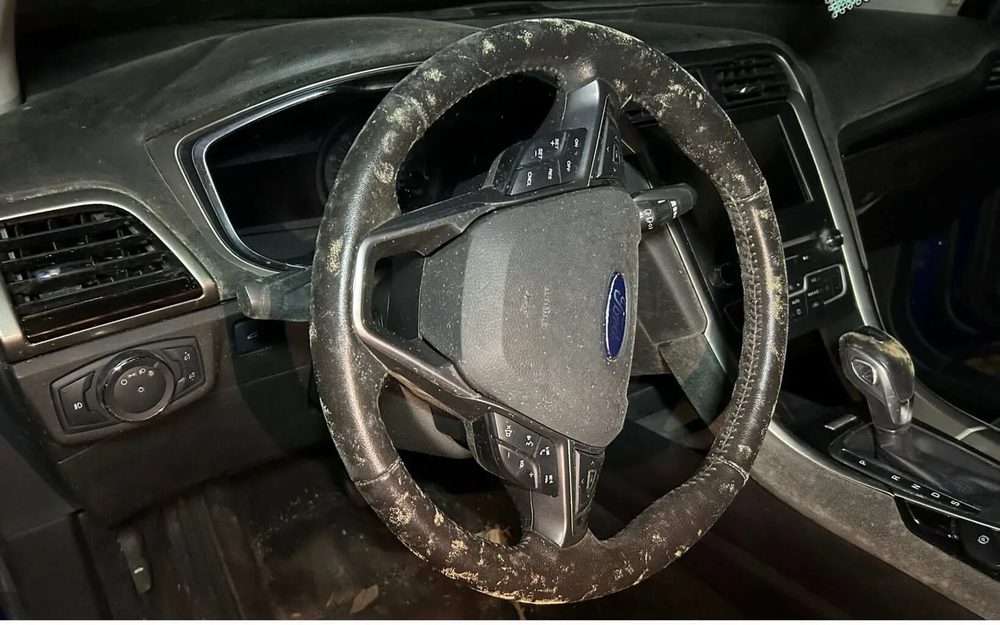
Steering Wheel, Dash & Vents — Grey-White Bloom
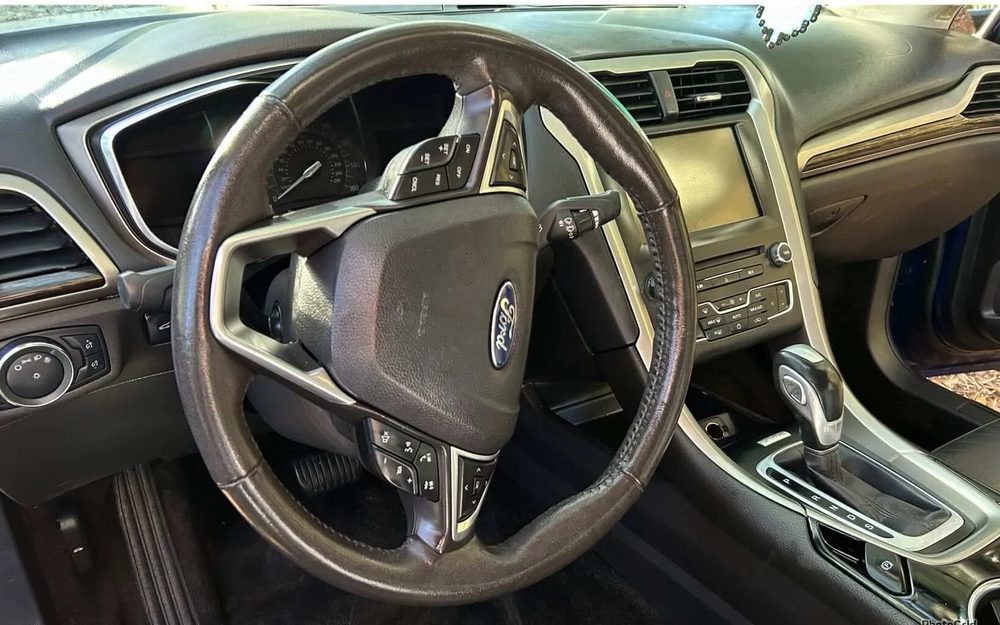
A Ford sedan interior with a grey-white mold bloom across the steering wheel, dash and vents. Hard surfaces are steam-cleaned, the vents are treated so growth inside the housings is reached too, and the cabin receives a Concrobium application and an ozone cycle. This pattern appears when a closed car sits in humid, still air for weeks, a common situation in older Coral Gables garages with little ventilation.
 Before
 After
Driver Seat & Console — Mold Bloom Beside a Lawn
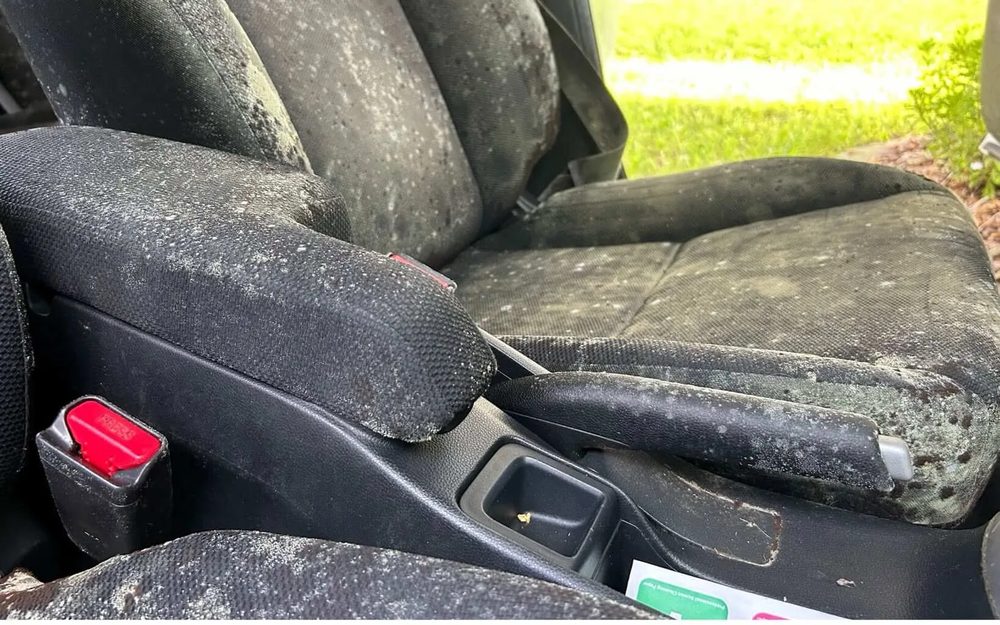
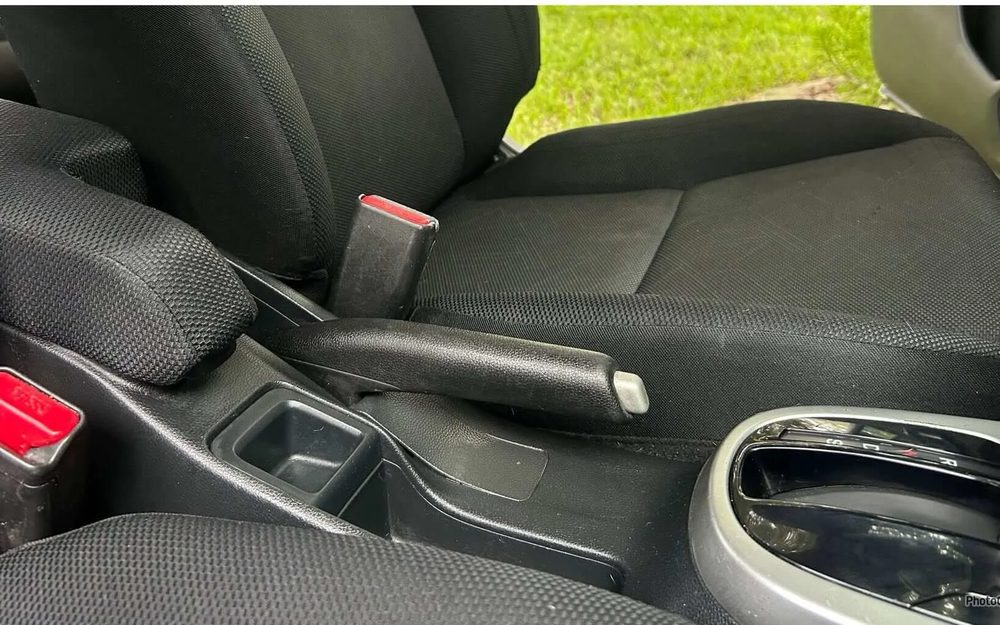
A black cloth driver seat, armrest and console with grey-white mold bloom, with a green lawn visible outside the window. Cloth takes steam and extraction well, followed by Concrobium and ozone, and the console and armrest get the same treatment. Cars parked beside lawns and planted beds in Coral Gables tend to sit in moist air that irrigation and tree shade keep refreshing.
 Before
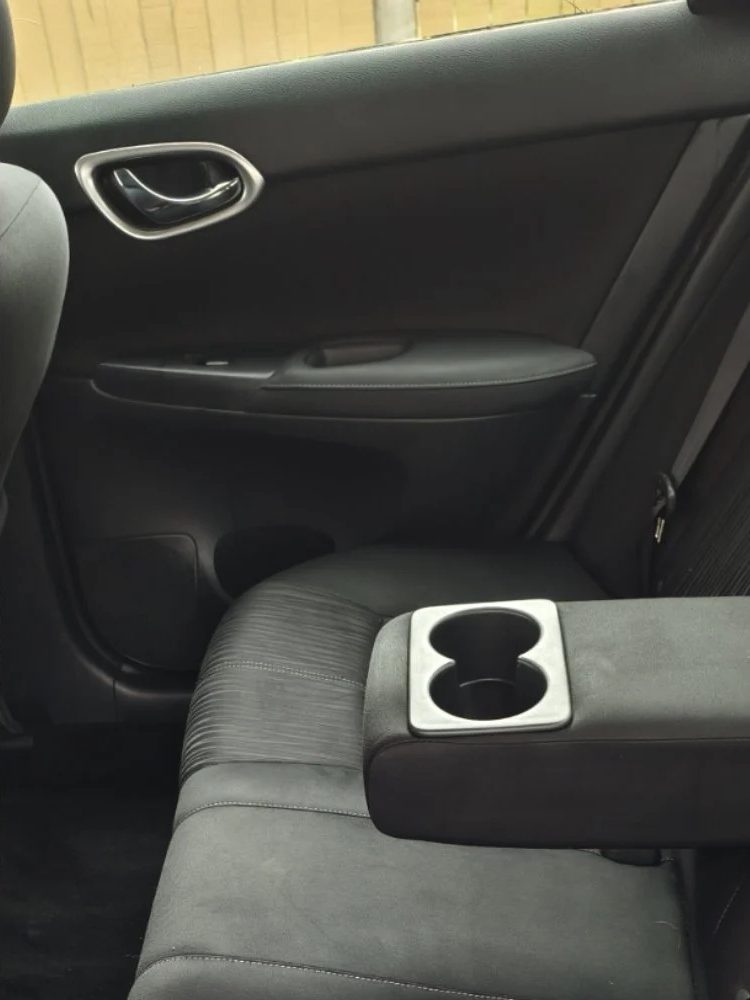 After
Rear Seat & Door Panel — White Mold Spots
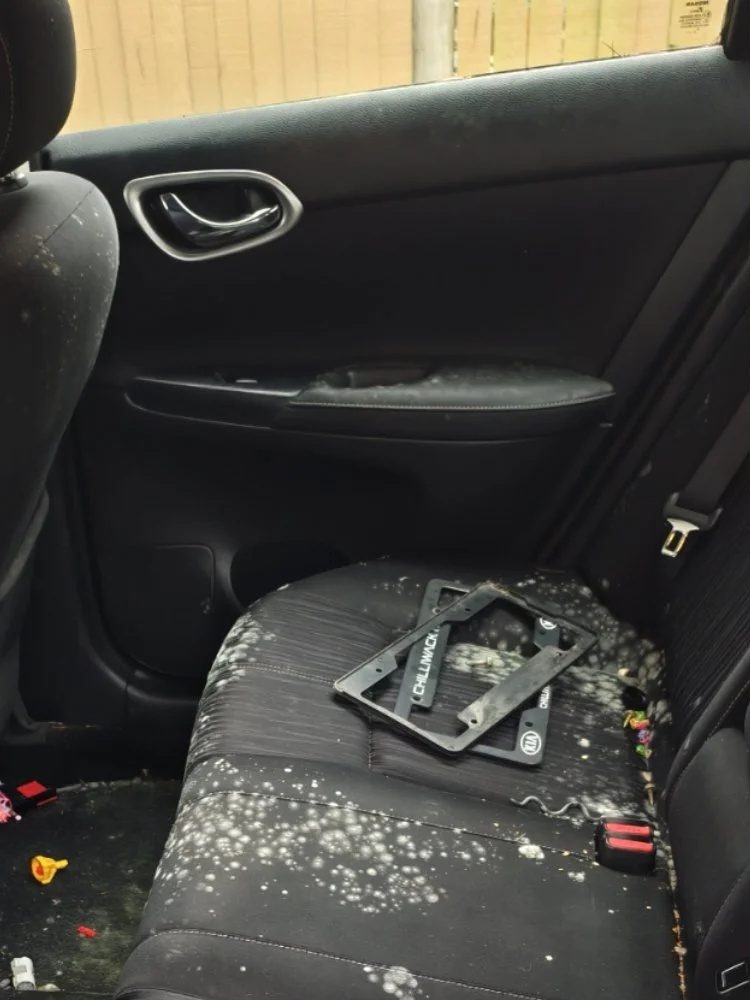
The rear seat and door panel of a black sedan, with white mold spots on the rear cushion plus loose debris and a license plate frame lying on the seat. The first step is clearing and vacuuming the loose items, then HEPA vacuum, steam, extraction and Concrobium. Rear seats are often forgotten between drives, and in a car shaded most of the day in Coral Gables, they can stay damp for weeks.
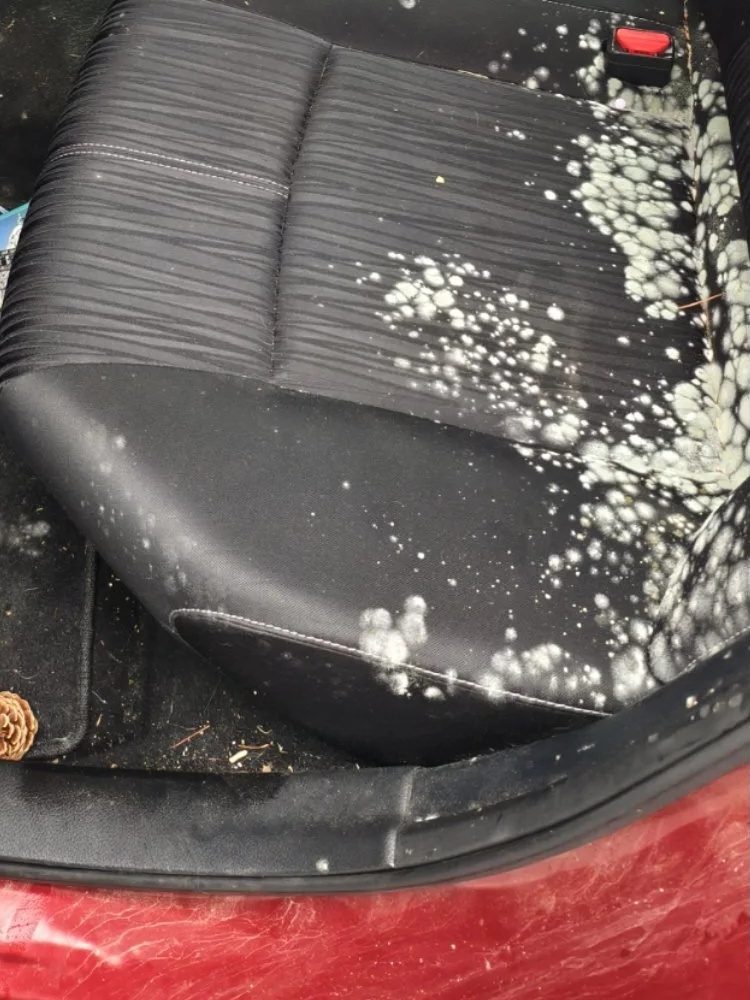 Before
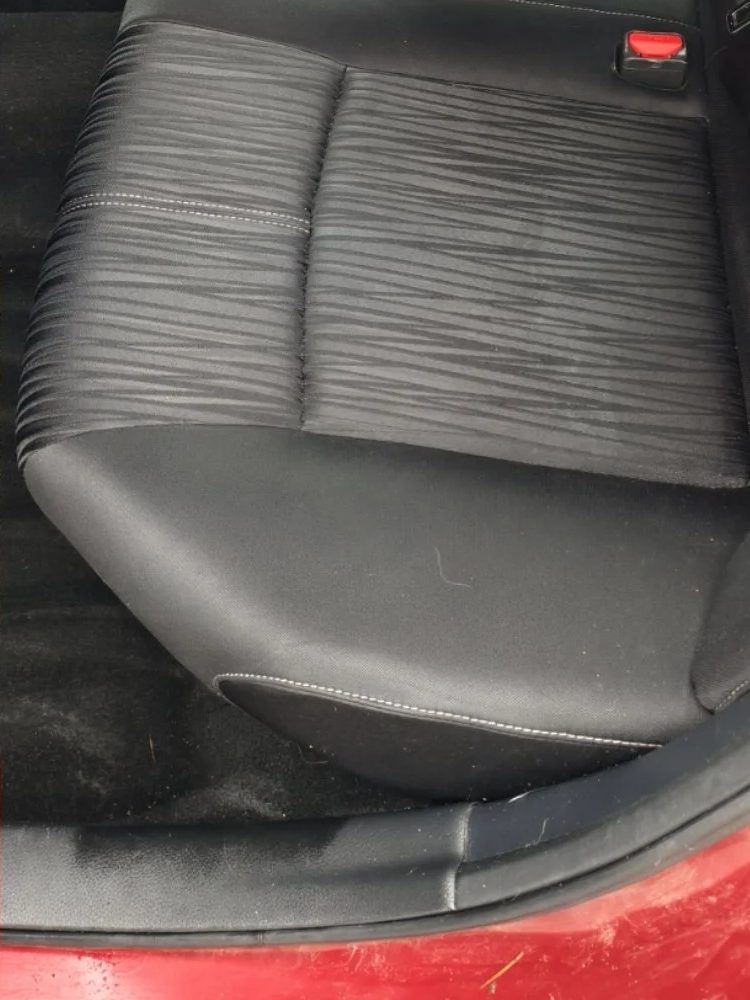 After
Black Cloth Seat — White Speckled Mold
A black cloth seat peppered with fine white mold speckles, with a red car body visible below the window. White speckling is often the early stage, which makes it the best moment to treat: steam, extraction, Concrobium and ozone usually clear it before it moves into the foam. Cars kept under tree cover in Coral Gables get enough daily moisture for this early stage to appear in a matter of weeks.
 Before
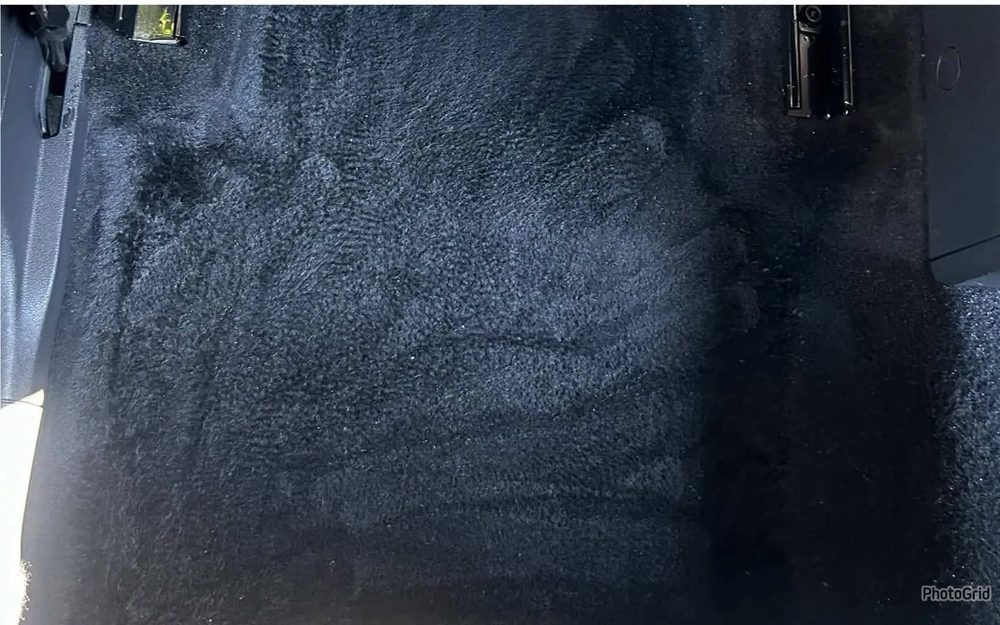 After
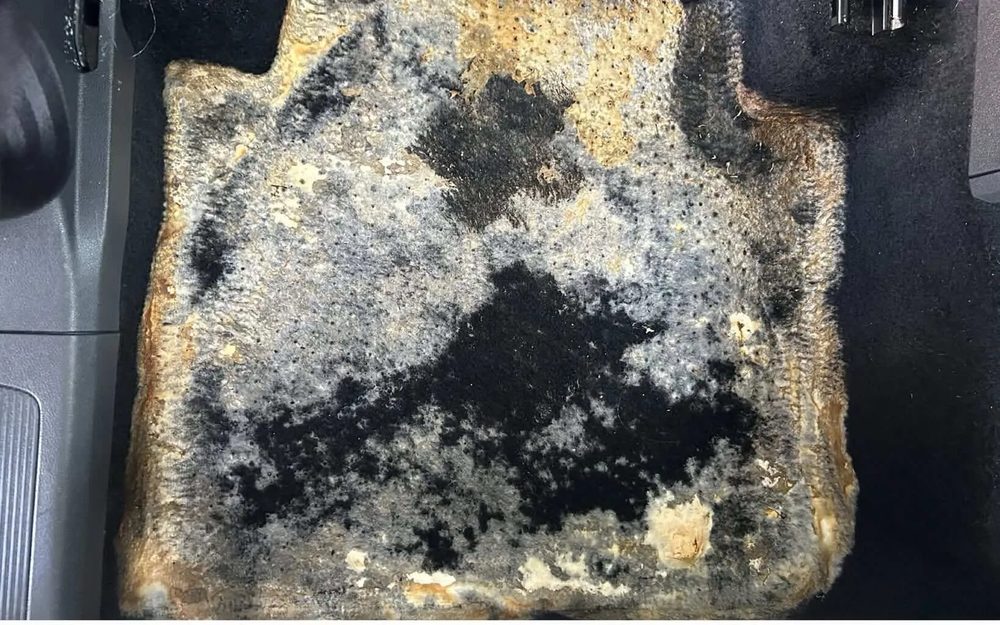
Floor Mat — Heavy Colony Growth
A carpeted floor mat with heavy black, brown and white mold colonies. Floor mats hold water from shoes, umbrellas and rain, and the carpet beneath rarely dries without help. We vacuum with HEPA, deep clean, steam and extract the carpet and padding below, treat with Concrobium and run ozone. In Coral Gables, wet mats under a dripping canopy are a classic starting point for the whole footwell.
100% Satisfaction.
Written. No exceptions.
If the result doesn’t meet our standard, or yours, we come back and redo it at no charge. No forms to fill out, no arguing over what “counts.” The guarantee is in writing before we ever touch your vehicle.
Request Mold Removal in Coral Gables · From $549
Fill this in once and send it. We get your address, vehicle, and the situation all in one message, no phone tag.
Rating
Detailed
Response
Three steps from a damp, musty cabin to a clean one,
even under a tree that never lets it dry. We handle the rest.
No drop-off. No waiting. We come to Coral Gables.
We come to you in Coral Gables,
from Miracle Mile offices to Cocoplum driveways.
Mobile service: home, office, condo, or marina. No drop-off, no travel fee.
Not seeing your city? Ask us — we likely cover it.
Shade, leaf-clogged drains and narrow garages
keep a parked Coral Gables car damp.
Coral Gables reports 58 percent tree canopy, so shade keeps glass, seals and carpets damp long after the sun would have dried them, and a car left sitting for a few weeks is already at risk. Left untreated, what starts as a musty smell becomes a real health issue for the next person who drives the car. DShine's Concrobium Mold Control and ozone process address the cause, not just the symptom, backed by $2M insurance and a written guarantee. Mold doesn't need much to get started, any trapped moisture inside a closed cabin is enough given South Florida's humidity. The source is almost always one of four things: a clogged AC condensation drain letting water pool silently on the floor pan, a failed door or window seal letting rain in, a clogged sunroof drain, or the car simply sitting unused for two or more weeks without the AC running. In the Gables, that last one is the cause we diagnose most, and it is usually slow drying, not one big event: leaf-clogged drains, tired seals and a narrow older garage or shaded driveway that never lets the cabin air out.
Coral Gables neighborhoods we serve,
from the Miracle Mile to Cocoplum.
From the Miracle Mile to gated Cocoplum, parking and shade change street by street in Coral Gables.
Miracle Mile & Giralda Plaza — The Miracle Mile is about half a mile of Coral Way between LeJeune and Douglas Roads, and Giralda Plaza is closed to through traffic. Parking is in nearby garages, where cars can sit all day in still concrete-trapped air. We usually meet at your home or office instead of the pedestrian blocks.
Granada Golf Course Area — The nine-hole Granada Golf Course opened in 1923 at 2001 Granada Boulevard. The residential streets around it are shaded by mature trees, with older homes whose garages are narrow. Cars here usually fail from slow drying and drains packed with leaves. We confirm the driveway width before arriving.
Biltmore Hotel & Biltmore Way — The Biltmore Hotel at 1200 Anastasia Avenue opened in January 1926, and Coral Gables City Hall stands at 405 Biltmore Way. Offices, civic buildings and homes share this corridor, so cars park in lots, driveways and garages. We agree a spot and access with your building contact in advance.
University of Miami Campus Area — The main campus covers about 240 acres in the city and sits next to the University Metrorail station. Student, faculty and staff cars here sit through breaks and long commutes, often in garages or lots. We work at your home, apartment or office, and photos by WhatsApp keep family out of town informed.
Venetian Pool & De Soto Boulevard — The Venetian Pool sits at 2701 De Soto Boulevard in a 1923 coral rock quarry setting, and the streets nearby are lined with trees and older homes. Cars parked on these shaded blocks stay damp after rain. We choose a driveway or curb spot with room for the doors and the equipment.
North Ponce — North Ponce is a residential area on the Ponce de Leon Boulevard side of town, and the city has planted dozens of shade trees there. Ponce de Leon is also the free trolley's north-south route. Commuter cars sit long hours with windows up, so a wet umbrella can start the problem.
Cocoplum & Gables Estates — Cocoplum and Gables Estates are gated communities near the bay, with private streets and, in many cases, long driveways and deep garages. Cars parked there between trips pick up humid air. We coordinate with the guard house or your property contact beforehand so the gate list is ready.
Don't see your area? Ask us — we likely cover it.
Coral Gables car mold,
the questions we hear most under the canopy.
Tap any topic to read the full breakdown.
No weather station sits inside the city limits, so the best stand-in is the one at Miami International Airport. Its 1991 to 2020 normals list roughly 67 inches of rain annually, about 141 days on which rain is measurable, and relative humidity averaging close to 73 percent. Mid-May to mid-October is the rainy stretch, and the Atlantic storm season officially spans June 1 to November 30.
What the airport figures miss is the leaf cover over the Gables. Coral Gables puts its citywide canopy at 58 percent, public and private land together, with nearly 39,000 trees along public rights-of-way, and it has held Tree City USA status since 1985. Under that much shade, glass, seals and carpets stay wet well after each shower, and fallen leaves pile where rainwater is meant to drain.
The typical Coral Gables call is a family sedan or SUV that sits most of the week under oaks and other mature street trees, then gives its owner a damp-carpet or musty-vent surprise after a rainy spell. These are rarely dramatic floods. They are everyday cars that never get a long, dry, sunny afternoon to open up and air out.
A second group is the household's less-used car: a spare kept in a carport or a narrow older garage, a teenager's hand-me-down, or a weekend convertible. Another is the commuter whose car waits all day while its owner rides Metrorail or the free city trolley. Parked for long hours with the windows up, a car can hold a single wet umbrella's worth of moisture for days.
Then there are the older cars, European sedans and the occasional classic, that belong to owners who value original leather and wood trim. Those jobs get a slower, gentler pass, and we tell you before work starts if a surface needs special handling. The first question is always the same: how long was it shut, and did anything wet go in?
Original garage or carport behind a 1920s-era home: Many homes here were planned when cars were smaller, so the garage is narrow, the door is tight and the space doubles as storage. Boxes against the walls stop air moving around the car, and an unconditioned garage swings with every weather change. The car sits in damp air for weeks, and the headliner and carpet pick it up first.
Street or driveway under the canopy: Overnight and weekend parking beneath big trees means drips, leaf litter and shade that keeps the car cool and wet. The paint dries, but the door jambs, window channels and the cowl under the windshield do not. If a drain clogs with leaves, water finds the footwell unseen, and sap and pollen on the glass add to a constant film of dampness.
Downtown and campus garages: Multi-level concrete garages near the Miracle Mile and the University of Miami are sheltered from rain, which helps, but concrete holds moisture and air barely moves. A car left a full day with a wet gym bag or beach towel inside is the pattern we see here, rather than months of neglect.
Gated waterfront streets: On gated streets such as Cocoplum and Gables Estates, cars often sit in long private driveways or deep garages, and humid bay air plus infrequent driving can do the same job as a closed-up garage anywhere else.
Mid-May to mid-October: The wet season is the main risk window. Afternoon downpours are routine, and canopy-covered streets stay dripping long after the sky clears. Every parked car gets daily dampness, so a small seal leak, a cracked sunroof or a damp footwell mat that would dry in a week in January lingers here and starts to grow.
June 1 to November 30, storm weeks: Hurricane season brings days when owners park inside, close up and wait. A car pulled into a narrow garage with the door shut, the A/C off and a damp interior can start growing in 24 to 48 hours, and a week of that is more than enough for visible spots on cloth and leather.
After a storm passes: Wind strips leaves and small branches from the canopy, and they pile on windshield cowls, roof rails and sunroof channels. If drains clog, the next rain overflows into the cabin. We often hear about musty smells in the weeks after a storm, not during it, once the debris has done its work.
Semester breaks and holiday travel: University summer break, the long holiday weeks and spring trips mean cars that sit untouched while their owners are elsewhere, and a closed car left three or four weeks in the wet season is the highest-risk case in town. From November to April the canopy has less to drip, so that stretch is the time to clear drains before the rain returns.
Coral Gables was laid out in the 1920s with winding drives and tree-lined boulevards, and the city counts more than 1,450 properties with local landmark designation. For a mobile crew that raises practical questions before arrival: where does the van pull in, how wide is the drive, and where is the shade for the car to rest during its sealed ozone period?
Before the visit we ask for a short note on parking: driveway, one-car garage, carport, condo space or a gated street. If a guard house or building office needs a name on its list, we sort that the day before, so nobody ends up idling at an entrance while the clock runs.
The car stays at its own address, whether home, office or a shared condo garage, and travel is included. A shaded driveway is a plus because the cabin stays cooler through steam and drying. If your street is tight or the drive is shared with a neighbor, tell us and we plan the setup so no one gets blocked in.
1. Debris-clogged drains and cowls under the trees: Leaves, seeds and flower litter gather at the base of the windshield and in sunroof drain channels. Once a drain blocks, rain backs up and drips into the footwell or headliner. This is the cause we meet most in the Gables, because the canopy keeps dropping material all year, and the first sign is usually damp carpet on one side.
2. Slow drying in shade: Cars parked beneath thick tree cover rarely dry out after a rainy spell. Door seals, window channels and trunk gaskets stay wet, and the cabin never gets a sun-baked afternoon to flush moisture. Over the wet season this slow-drying cycle alone is enough to produce white mold on carpet and fabric.
3. Narrow older garages with stored items: A one-car garage built decades ago and stacked with boxes holds humid air around the car. A damp towel or a wet umbrella left inside for the week makes it worse. This cause often combines with the first two, so we check all three on every visit.
4. A clogged A/C evaporator drain or a worn seal: Water that should leave under the car collects behind the dash instead, turns musty and gets blown into the cabin when the fan starts. Door seals worn by years of sap and sun, or a window left cracked before a storm, start small and spread through foam and padding. Many owners first notice the smell in the first minute the A/C runs.
Every visit begins with an arrival window and a quiet corner of the driveway, preferably under a tree, since shade keeps the cabin from baking. We take a slow lap around the car with you, photograph what we find and weigh it against your description. Then the price is locked in. Three to four hours is the usual span.
The work runs in a fixed order of eleven stages. Inspection and a HEPA pass come first, then Benefect to decontaminate and a deep clean, then steam and extraction followed by drying. Concrobium Mold Control goes on next, ozone handles the air, and the Meguiar's odor bomb and a closing check finish it. Cloth is steamed and extracted; leather gets its own protocol so the finish survives.
Then WhatsApp lights up with before and after photos and a frank note on what we saw. A leaf-packed cowl, a tired door seal or a garage with no air movement gets named, so the car is not delivered back into the exact conditions that caused the trouble. Stay with us for the visit or go about your day; both work.
The first question is usually about access: my driveway is narrow, or I park on the street, can you still work? Almost always the answer is yes. We only need enough room to open the doors and run the equipment, and we tell you ahead of time which spot works best, including whether shade or a garage bay is the better choice.
Next comes how bad it is and what it costs. A couple of photos of the carpet, the seats and any visible spots usually settle whether this is a one-area job at $549 or a whole-car job at $749. Callers who live near the university or downtown often add a question about parking in a garage or shared lot, and we plan around that.
Many owners also want to know whether the smell is safe for children and pets, how long the car is out of action and whether the problem will come back. The 30-day written guarantee answers the last one, and we explain the cause we found so you can address it before the next rainy spell.
Paint Correction is a common pairing. Paint parked under trees collects sap spots, pollen and leaf stains, so a car that needs interior mold treatment often looks tired outside too, and owners prefer to handle both in one visit rather than scheduling twice and clearing the driveway two times.
Ceramic Coating comes next, particularly for owners who want a surface that sheds leaf residue and sap more easily once the cabin is clean. Engine Bay Cleaning is a smaller but steady add-on, since the same debris that blocks a cowl drain also collects around the engine bay. Any additional work is confirmed with you before it starts.
If you are unsure whether you need mold removal or something lighter, Odor Removal Detailing ($349) covers odors without visible mold, and Flooded Car Detailing ($349) is for water entry caught early. A few photos tell us which one fits, and we say so honestly even when it is the cheaper choice.
Fogged glass on a cool morning is the earliest clue, particularly if the car spent the night beneath trees. If the inside of the windshield stays hazy after the defroster has run a few minutes, moisture is already in the cabin and worth a closer look before any smell arrives.
Press your palm into the carpet beneath the dash and along the door sills. Cold dampness, a spongy feel or a dark patch near the firewall points to a leaking drain or seal. Lift the trunk floor and the spare-tire well too; those places collect water and rarely get opened, so trouble there can go unseen for months.
Outside, look at the rubber around the doors and windows. A green or black film on a shaded car usually means it is staying wet. A musty whiff in the first seconds of the A/C is the last warning before spots show on seats and trim, and it is worth acting on that same week.
Before any stretch of idle time, take out whatever is damp: umbrellas, gym bags, towels and food wrappers. For the last few minutes of your drive, set the A/C to fresh air and warm it up a little so the evaporator can dry before the doors close and the car is left alone.
Sweep leaves from the base of the windshield and the sunroof channel, and make sure the drain slots are open. For a car that lives under a tree, moving it once a week, even ten minutes with the windows down on a dry afternoon, changes the cabin air more than most owners expect.
In a narrow garage, leave a few feet around the car and keep cardboard off the walls. Desiccant packs help a small cabin but do not replace airflow. A breathable cover is acceptable, whereas a plastic tarp traps moisture against the paint and makes matters worse.
Coral Gables households often share one garage and one driveway among two or three cars. If one has mold, the others deserve a look, because they breathe the same damp air and often share the same leaf-covered drains. A glance at the second car during the first visit saves a second call later.
We can look at several vehicles in one visit, but every car is priced separately from photos, since one may be a single-area job and the next a whole-vehicle job. Nothing is bundled or assumed, and the exact number for each car is confirmed before we begin.
If you manage cars for a household, a student or a visiting relative, send photos of each and say where each is parked. We then decide the order of work, the setup spot and how long each car needs to air, so the driveway stays open as much as possible, and photos come back for every vehicle.
Thirty days of written coverage follow the visit. Should mold or a mold smell reappear inside that window, we return and re-treat the car free, under a full satisfaction guarantee. The only thing we need from you is a message saying the odor or spots are back, and a return visit gets booked.
Around the Gables, a return nearly always has a root cause nobody dealt with: a drain still clogged with leaves, a seal that still weeps, or a car parked back in the same dripping spot with a soaked item inside. If we spot the likely source, we tell you directly so it can be fixed.
What the guarantee protects is the growth we removed coming back. A fresh water event, such as another storm through an open window, is a separate matter that we handle fairly after talking it through. For the whole 30 days, the original problem stays ours.
Many Coral Gables owners keep an older sedan, a European coupe or a weekend classic in the family. Original leather, wood trim and older stitching need more patience than a late-model daily driver. We test products on a hidden area first and use the leather-safe protocol instead of aggressive scrubbing.
Steam is applied carefully around trim and electronics, and extraction takes the moisture out of foam and padding. Concrobium is applied to affected surfaces, and ozone handles the cabin air and vents. We explain which surfaces we are treating and why, so you know what is happening to your car.
If something is delicate, such as original cloth that has worn thin or a crack-prone dashboard, we tell you before we begin and agree on a gentler approach. The goal is to remove the mold and keep the car's originality intact, which takes more time than rushing through a modern interior.
Take everything that holds water out of the car, including umbrellas, damp towels, gym clothes, shopping bags and cups. Then lift each floor mat. A wet mat sitting on carpet is the classic seed of a colony, and it is what people forget most when they are rushing to the airport.
Sweep leaves off the cowl at the base of the windshield and out of the sunroof drain slots. During the last minutes of the drive, set the A/C to fresh air so the evaporator dries. Park somewhere air can move around the car, and slide any boxes away from the garage walls.
Ask whoever is staying behind to start the car and run the A/C, windows cracked, on a dry day every week or two. And if a seal looks worn or the carpet feels damp, get it checked before you leave, not after you come home to a smell.
Mold does not pause while you decide. In a warm, shaded car, spots on a seat bolster can creep into foam and padding within weeks, and a one-area problem at $549 can become a whole-vehicle job at $749 once the headliner and carpet join in.
The longer growth sits, the deeper it reaches: seat foam, padding, door cavities and the ductwork behind the dash. A job caught while only the carpet is touched is simpler than one where the vents are blowing spores toward the people inside.
There is also a daily cost. A car you hesitate to open, or hesitate to drive with children or someone with allergies, is a constant irritation. A small spot noticed early does not call for panic, but the math rarely favors waiting for the next wet season.
The University of Miami's main campus covers about 240 acres inside Coral Gables, and the university was chartered in April 1925, the same month the city was incorporated. Cars connected to it come in every kind: a student's first car, a professor's daily driver or a staff member who rides the Metrorail and leaves the car for long stretches.
The mold pattern here follows the academic calendar. A student's car that sits through summer break or a long holiday, windows up, with a damp gym bag or spilled drink inside, is a classic. Cars that spend all day in a garage or lot face humid, still air, and a single wet item can be enough.
We work at the address where the car is parked, such as a home, an apartment or an office, and we confirm access beforehand. If a parent or family member is arranging the job from out of town, photos and WhatsApp updates keep them in the loop without anyone needing to be present.
Photos do most of the pricing work. Capture the worst seat, the carpet under the dash, the headliner and any patch that looks fuzzy or stained, then add a line saying how long the car sat and where. Within 2 minutes you hear back which tier applies, and travel to your Coral Gables address is already included.
Two tiers exist. One affected area, whether a seat, a section of carpet or a door panel, costs $549. Mold that has spread throughout the cabin costs $749. After we review your photos and description, the exact figure is confirmed, always before anything is opened or sprayed.
After that, the number stays put. If the car looks different in person, we explain what changed and agree on any adjustment with you first. A car that spent a rainy summer in shade tends toward the larger tier, while one caught after a single soaked afternoon often stays in the smaller one.
The short version for the Gables: canopy is the whole story. Fifty-eight percent of the city is under tree cover, so parked cars shed rain slowly, leaves choke the drains at the base of the windshield and old narrow garages keep the air heavy. Mid-May to mid-October is the wet season, and storms can arrive any day from June 1 to November 30.
What it costs: $549 when one area is affected, $749 when it has reached the whole vehicle, and travel to your address is included either way. A visit takes roughly three to four hours, and WhatsApp carries the before and after photos back to you.
What stands behind it: Concrobium and ozone on every job, a leather-safe approach for leather, IDA certification, $2 million in liability insurance and a written guarantee that lasts 30 days. Ask us whatever you like before you book.
After the steam, extraction and Concrobium stages, the car is closed up and a professional ozone generator runs in the cabin. Where a cloth only reaches what it touches, ozone circulates through the vent ducts and the voids inside seat foam. Nobody sits in the car for the cycle, and people and pets should stay well away from it.
On a shared Gables driveway or in a narrow garage, we tell you beforehand how long the car will be sealed. If the car needs to sit in shade so the cabin does not bake, we choose that spot, and we mark the car so nobody opens a door halfway through.
When the generator stops, we open every door and let the cabin air through until it is comfortable to sit in, then finish with the Meguiar's odor bomb and a last inspection. You hear from us when the car is truly ready to drive, not merely when the machine switches off.
Before you book,
answers for Coral Gables drivers.
Add-ons Coral Gables clients book
Still deciding? Read: the complete mold removal guide · does insurance cover it? · why DIY mold removal fails.
Mold in your Coral Gables car? Get your price in under 2 minutes.
Serving Coral Gables and all of Miami-Dade County. Fixed pricing, no travel fee. We confirm in under 2 minutes.
It Might Just Be an Odor Problem
If there's no visible mold growth yet, the smell alone is usually an Odor Removal Detailing case ($349 flat) — faster than full mold remediation ($549–$749). See which one matches what you're dealing with: